




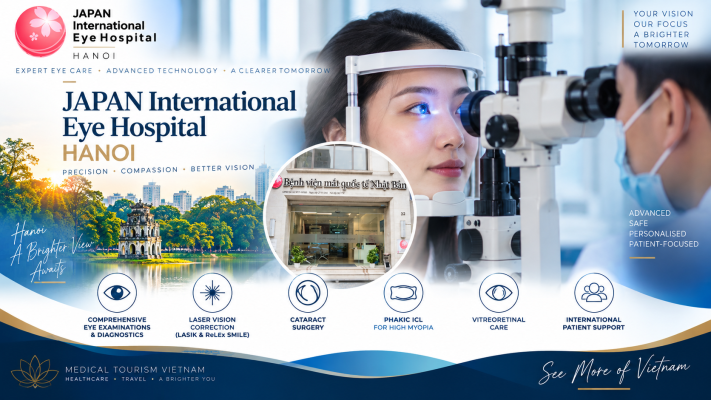
Japan International Eye Hospital Hanoi
Japan International Eye Hospital (JIEH) is a specialist ophthalmology hospital located in Ba Dinh District, Hanoi, providing eye examinations, diagnostic services, refractive surgery and treatment for a range of eye conditions.
For international patients considering eye treatment in Vietnam, the hospital offers a dedicated ophthalmology environment rather than eye care as one department within a large general hospital.
Medical Tourism Vietnam provides this profile to help patients understand the services available and the questions they should consider before seeking assessment or treatment.
About Japan International Eye Hospital
Japan International Eye Hospital is located at 32 Pho Duc Chinh Street, Ba Dinh, Hanoi, close to Truc Bach Lake and West Lake. The hospital has operated in Hanoi since 2014 and describes itself as a Japanese-invested specialist eye hospital.
Its services extend from routine vision testing and specialist eye examinations to laser vision correction, lens-based refractive procedures, cataract surgery and treatment of retinal and other ophthalmic conditions.
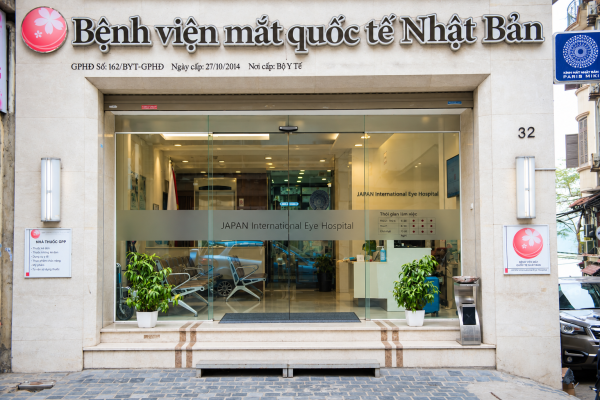
Japan International Eye Hospital at 32 Pho Duc Chinh Street, Ba Dinh, Hanoi.
Eye Examinations & Diagnostic Assessment
Appropriate diagnosis should come before a decision about surgery.
JIEH’s published patient pathway begins with registration and basic eye-function testing, which can include automated refraction, intraocular-pressure measurement and vision testing. Depending on the patient’s condition, an ophthalmologist may then recommend additional investigations.
The hospital lists diagnostic capabilities including OCT imaging, ultrasound, visual-field measurement, endothelial-cell assessment and corneal topography.
The investigations required will depend upon the patient’s symptoms, medical history and proposed treatment.
Laser Vision Correction
Refractive surgery is one of JIEH’s principal treatment areas.
The hospital currently lists several refractive procedures, including ReLEx SMILE, Femtosecond LASIK, SBK LASIK and other approaches. It also provides lens-based refractive surgery for selected patients.
The appropriate procedure should be determined following detailed examination rather than selected solely according to technology, price or advertising.
Femtosecond LASIK
Femtosecond LASIK uses a femtosecond laser to create the corneal flap before laser reshaping of the underlying corneal tissue.
Suitability depends on factors such as refractive error, prescription stability, corneal characteristics and overall eye health.
Explore: Femtosecond LASIK in Vietnam
ReLEx SMILE
ReLEx SMILE uses a femtosecond laser to create a small piece of tissue within the cornea that is removed through a small incision, reshaping the cornea without creating the larger flap associated with LASIK.
JIEH currently lists ReLEx SMILE among its refractive-surgery services.
Explore: ReLEx SMILE Surgery in Vietnam
Phakic ICL Surgery
For some patients who are not appropriate candidates for corneal laser surgery, a lens-based approach may be considered.
Phakic ICL surgery involves placing an implantable lens inside the eye while retaining the patient’s natural lens. JIEH includes Phakic ICL within its current refractive-surgery services.
Whether this approach is appropriate depends on detailed measurements and assessment by an ophthalmologist.
Patients should discuss the benefits, limitations, risks, long-term monitoring requirements and alternative approaches before deciding upon treatment.
Cataract Surgery
JIEH provides both conventional phacoemulsification and femtosecond laser-assisted cataract surgery.
Cataract surgery involves removing the cloudy natural lens and replacing it with an artificial intraocular lens.
Choosing an intraocular lens is an important part of treatment planning. Different lens designs may have different implications for distance, intermediate and near vision.
International patients should discuss their visual priorities, eye health, proposed lens, follow-up schedule and travel plans with the treating ophthalmologist.
Retinal Care
Retinal disease encompasses many different conditions, some of which can threaten vision and require specialist treatment.
JIEH lists retinal treatment including vitrectomy, retinal laser photocoagulation and scleral buckling among its services.
The appropriate treatment depends entirely upon diagnosis.
Sudden loss of vision, new flashing lights, a sudden increase in floaters or a curtain-like shadow across the field of vision can require urgent medical assessment. Patients experiencing acute symptoms should seek appropriate care promptly rather than delay treatment in order to travel internationally.
Other Eye-Care Services
JIEH’s current service portfolio also includes screening and treatment pathways beyond refractive and cataract surgery.
These include glaucoma screening, retinal degeneration screening, Ortho-K, vision testing and various ophthalmic procedures involving conditions such as strabismus, eyelid disorders, pterygium and tear-duct obstruction.
Not every service or procedure will be appropriate for every patient. Specialist examination remains necessary before treatment recommendations can be made.
Technology & Facilities
Modern ophthalmology relies heavily on diagnostic and surgical technology, particularly for refractive, cataract and retinal procedures.
JIEH currently identifies equipment associated with refractive and cataract treatment including ZEISS VisuMax and MEL 90 systems, together with ophthalmic imaging and measurement equipment.
Technology is an important consideration, but patients should also consider the experience of the treating ophthalmologist, quality of pre-operative assessment, appropriateness of the recommended procedure and arrangements for follow-up care.
International Patients Considering Treatment in Hanoi
Travelling internationally for eye treatment requires more than choosing a procedure and booking a flight.
Before confirming treatment, patients should establish:
- what medical and ophthalmic records should be supplied;
- whether an initial remote review is possible;
- what examinations must be performed in Hanoi;
- the expected treatment schedule;
- how long they should remain in Vietnam;
- when follow-up examinations will occur;
- when they may safely fly;
- what medications or eye drops will be required;
- how complications are managed; and
- what continuing care may be required after returning home.
Patients should avoid booking inflexible return travel until the treating ophthalmologist has advised how long they should remain in Vietnam.
Medical Tourism Vietnam & Japan International Eye Hospital
Medical Tourism Vietnam has maintained an interest in Japan International Eye Hospital for a number of years as part of our development of eye-care information and treatment pathways in Hanoi.
Our role is to help international patients understand available options, prepare appropriate information and, where suitable, facilitate preliminary communication concerning assessment and treatment.
Medical Tourism Vietnam does not determine whether a patient is suitable for surgery. Diagnosis, treatment recommendations and clinical decisions remain the responsibility of the treating ophthalmologist.
Note: I have deliberately not repeated the old page’s “partnership since 2018” claim here yet. If you have the original partnership correspondence or are personally certain that a formal partnership was established in 2018, we can change the first sentence to state that explicitly. I don’t want us converting an old website statement into a current contractual claim without knowing its present status.
Questions to Ask Before Treatment
International patients considering JIEH may wish to ask:
- Which treatment do you recommend for my condition and why?
- What alternatives should I consider?
- Who will perform my procedure?
- What experience does the ophthalmologist have with this treatment?
- What diagnostic examinations are required?
- What are the important risks in my individual case?
- What does the quotation include?
- How many follow-up examinations are required?
- How long should I remain in Hanoi?
- When can I safely fly home?
- What happens if I develop a complication after leaving Vietnam?
- What medical records will I receive for my eye-care provider at home?
Clear answers to these questions can help patients make a more informed decision.
Explore Eye Surgery & Vision Care in Vietnam
Japan International Eye Hospital is one provider within Vietnam’s developing ophthalmology sector.
For information about vision correction, cataract surgery, retinal conditions, glaucoma, corneal care and other treatment considerations, visit our main patient guide.
Explore: Eye Surgery & Vision Care in Vietnam
Further Reading
Medical Tourism Vietnam’s associated publication, Hanoi Trading Post, publishes independent features on Vietnam, healthcare, culture and developments across Asia.
We do not currently have a dedicated Hanoi Trading Post feature about JIEH or ophthalmology, so we will not manufacture an unrelated article link simply for SEO purposes.
This also gives us a future editorial opportunity: an HTP feature examining the development of specialist eye care in Hanoi, which could then link naturally back to this resource.
Considering Eye Treatment at Japan International Eye Hospital?
Medical Tourism Vietnam can assist international patients who would like to explore treatment at Japan International Eye Hospital or understand other eye-care options available in Vietnam.
We can help patients identify the information that may be required for preliminary assessment and facilitate initial communication regarding potential treatment pathways.
Enquire: Contact Medical Tourism Vietnam
There is no obligation to proceed. Final medical suitability, treatment recommendations and quotations are determined by the treating healthcare provider following individual assessment.
Medical Disclaimer
The information on this page is provided for general educational purposes and does not constitute medical advice, diagnosis or an endorsement or guarantee of a particular healthcare provider or treatment.
Services and technologies offered by healthcare providers can change. Patients should confirm current services, costs, clinician availability and treatment arrangements before travelling.
Suitability for eye surgery or other ophthalmic treatment can only be determined following individual assessment by an appropriately qualified healthcare professional.
About the Author
George Adams is the Founder and Editor of Medical Tourism Vietnam. Drawing on many years of experience living and working in Vietnam and across Asia, he develops patient-focused information designed to help international visitors better understand healthcare and medical-travel options in the region.
Editorial Policy
Medical Tourism Vietnam aims to provide clear, balanced and patient-focused information about healthcare and medical travel. Provider inclusion does not constitute a guarantee of treatment suitability or outcome. Medical decisions remain between the patient and appropriately qualified healthcare professionals.
Last Reviewed: 9 September 2026