




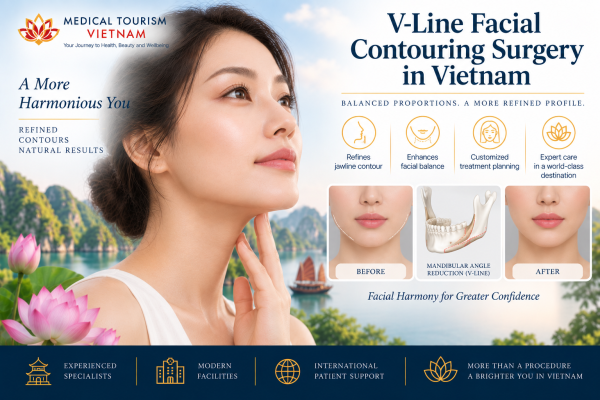
V-line facial contouring is a form of facial bone surgery designed to change selected aspects of the lower jaw and chin.
Unlike treatments that primarily alter skin or soft tissue, V-line surgery can involve surgical modification of the mandible and chin bone. The objective may be to reduce the width or angularity of the lower face, alter chin proportions or create a different relationship between the jawline and chin.
The term V-line surgery can describe different combinations of procedures. The existing Medical Tourism Vietnam page, for example, describes it as a combination of mandibular reduction and chin reduction.
Because this is significant skeletal surgery, patients require careful assessment of facial proportions, bone structure, dental relationships and important nerves before treatment.
Patients researching V-line surgery may also wish to explore Facial Cosmetic Procedures in Vietnam.
What Is V-Line Facial Contouring?
V-line surgery generally aims to modify the contours of the lower face.
Depending on the patient’s anatomy, surgery may involve:
- Mandibular angle reduction
- Contouring of the lower border of the jaw
- Reduction of selected areas of the mandible
- Chin narrowing or reshaping
- Genioplasty
- A combination of jaw and chin procedures
Not every patient requires all of these procedures.
The surgeon should determine which skeletal structures are contributing to the patient’s facial proportions before recommending treatment.
Mandibular Angle Reduction
The mandible is the lower jawbone.
In some patients, prominent mandibular angles contribute to a wider or more angular appearance of the lower face.
Mandibular angle reduction involves surgically modifying selected areas of this bone.
The amount and location of bone modification require careful planning because the mandible is not simply an external facial contour. It supports the teeth and is associated with muscles, blood vessels and important sensory nerves.
Chin Surgery and Genioplasty
The chin plays an important role in frontal and profile facial balance.
V-line surgery may therefore include modification of the chin as well as the jaw.
Genioplasty involves surgically modifying or repositioning the patient’s own chin bone. Depending on anatomy and objectives, it can alter:
- Chin width
- Projection
- Height
- Symmetry
- Shape
The existing V-Section page itself refers to sliding genioplasty as a technique for changing a broad or blunt chin.
Patients considering less extensive chin augmentation can also read our guide to Chin Implants in Vietnam, which explains the important distinction between implants, mentoplasty and genioplasty.
V-Line Surgery and Facial Balance
A narrower jaw is not automatically a more balanced jaw.
The lower face should be assessed in relation to:
- Cheekbones
- Facial width
- Chin projection
- Chin height
- Dental relationships
- Jaw symmetry
- Nose and facial profile
- Overall facial proportions
Treatment should therefore be based on the individual’s anatomy and objectives rather than attempting to reproduce a standardised facial shape.
There is no single ideal face shape for women or men.
V-Line Surgery Is Bone Surgery
This distinction is important.
V-line surgery is sometimes discussed alongside ordinary cosmetic procedures, but mandibular reduction and genioplasty involve facial bones.
This makes appropriate surgical training, imaging and anatomical planning particularly important.
Patients should understand exactly:
- Which bones will be modified
- How much bone is expected to be removed or repositioned
- Which nerves are located near the surgical area
- Whether the dental bite could be affected
- What imaging is required
- How facial symmetry will be evaluated
- How complications would be managed
The operation should not be approached as simply “making the face smaller.”
Nerve Anatomy and Sensation
Important sensory nerves pass through the mandible.
In particular, branches of the inferior alveolar nerve and mental nerve provide sensation to areas including the lower lip and chin.
Surgery around the lower jaw therefore requires careful planning to minimise the risk of nerve injury.
Temporary altered sensation can occur after some jaw and chin procedures. Persistent sensory changes are a more significant potential complication.
Patients should ask their surgeon specifically about nerve location, surgical planning and the risk of temporary or permanent sensory changes.
Who May Be Suitable?
Potential candidates may include adults whose lower facial proportions are significantly influenced by skeletal jaw or chin anatomy and who understand the extent and limitations of surgery.
Assessment should consider:
- Facial bone structure
- Jaw width and shape
- Chin dimensions
- Facial symmetry
- Dental bite
- General health
- Previous facial surgery
- Previous jaw surgery
- Medications
- Smoking and nicotine use
- Healing history
- Treatment expectations
A desire for a fashionable facial shape alone is not sufficient clinical justification for skeletal surgery.
Imaging and Surgical Planning
Because V-line procedures involve facial bone, imaging may form an important part of assessment and surgical planning.
Depending on the procedure, this can help the surgical team evaluate:
- Mandibular anatomy
- Chin structure
- Facial asymmetry
- Tooth roots
- Dental relationships
- Nerve pathways
- Previous skeletal surgery
Three-dimensional planning may sometimes be used to help assess proposed changes.
Computer simulations should be regarded as planning and communication tools rather than guarantees of the final result.
What Happens During V-Line Surgery?
The operation depends on which skeletal structures are being treated.
Surgery may involve carefully cutting, contouring or repositioning selected areas of the mandible or chin.
Access is often planned to minimise visible external scars, although the exact surgical approach depends on the procedure.
Bone-cutting techniques and instruments vary between surgeons and facilities.
The existing MTV page promotes particular endoscopic and ultrasonic technologies. Rather than assuming that a named technology guarantees a better result, patients should focus on the surgeon’s qualifications, planning, anatomical knowledge and experience with the specific operation.
Anaesthesia and Surgical Facility
V-line skeletal contouring is a substantial surgical procedure.
Patients should establish:
- What type of anaesthesia will be used
- Who will administer the anaesthesia
- Whether the facility is appropriately equipped for facial bone surgery
- What monitoring will be provided
- Whether hospital admission is required
- What emergency support is available
These considerations are particularly important for international patients comparing providers.
Recovery
Swelling following mandibular and chin surgery can be substantial and may take time to resolve.
Patients may also experience temporary tightness, altered sensation and changes related to eating or oral care.
Recovery varies according to the extent of surgery and individual circumstances.
The treating surgeon should provide specific instructions regarding:
- Oral and incision care
- Diet
- Physical activity
- Swelling management
- Dental hygiene
- Medication
- Follow-up examinations
- Returning to work
- Air travel
- Symptoms requiring urgent assessment
Patients should not rely on generic online recovery timelines when planning facial bone surgery.
When Will the Result Be Visible?
The final result should not be judged during early recovery.
Swelling can significantly alter the apparent shape of the lower face following surgery.
As healing progresses and swelling decreases, the underlying facial contours become easier to assess.
Bone and soft tissues also require time to heal and adapt.
The surgeon should explain when the result can reasonably be evaluated based on the particular operation performed.
Risks and Possible Complications
V-line facial contouring carries risks associated with both surgery generally and facial bone surgery specifically.
Potential complications can include:
- Bleeding
- Infection
- Swelling
- Delayed healing
- Asymmetry
- Contour irregularities
- Changes in lower-lip or chin sensation
- Nerve injury
- Dental injury
- Bone-healing problems
- Changes in soft-tissue support
- Unsatisfactory cosmetic outcome
- Anaesthesia-related complications
- Need for revision surgery
The precise risks vary according to the procedures performed.
Patients should understand both common complications and less common but potentially significant problems before consenting to surgery.
V-Line Surgery Versus Non-Surgical Facial Contouring
Non-surgical facial contouring cannot reproduce the skeletal changes produced by mandibular or chin osteotomy.
Treatments affecting fat, muscle, skin or facial volume may alter appearance in selected patients, but they do not physically reshape the jawbone.
Conversely, someone whose facial width is primarily related to soft tissue rather than skeletal structure may not necessarily benefit from bone surgery.
Correctly identifying the anatomical cause of the patient’s concern is therefore fundamental.
Why Consider V-Line Surgery in Vietnam?
Vietnam has a developing cosmetic and specialist surgical sector, particularly in Ho Chi Minh City and Hanoi.
For V-line surgery, provider selection requires considerably more than comparing cosmetic surgery prices.
International patients should consider:
- Surgeon’s qualifications
- Specific experience in facial bone contouring
- Experience with mandibular surgery and genioplasty
- Preoperative imaging and planning
- Anaesthesia arrangements
- Surgical facility standards
- Postoperative monitoring
- Management of nerve-related complications
- Follow-up care
- Revision policies
- International patient support
Patients should ask how frequently the surgeon performs the specific skeletal procedure being proposed.
Planning V-Line Surgery in Vietnam
International patients should allow adequate time for consultation, imaging, surgery and postoperative assessment.
Before travelling, establish:
- What preoperative imaging is required
- How long you should remain in Vietnam
- Whether hospital admission is expected
- When postoperative reviews will occur
- What dietary restrictions may apply
- When the surgeon considers air travel appropriate
- How significant swelling may affect travel
- What follow-up is available after returning home
- How complications would be managed
- What happens if revision surgery becomes necessary
The medical and recovery plan should determine the travel itinerary.
Questions to Ask Your Surgeon
Before proceeding, consider asking:
- Which bones are you proposing to modify?
- Why is skeletal surgery appropriate for my anatomy?
- Do I need mandibular reduction, genioplasty or both?
- How will you assess my facial proportions and symmetry?
- What imaging will be performed?
- Where are the important nerves in relation to the planned bone cuts?
- What is the risk of altered lower-lip or chin sensation?
- Could my dental bite be affected?
- How frequently do you perform this operation?
- What are the major complications?
- How long should I remain in Vietnam?
- How would a complication be managed after I return home?
Considering V-Line Facial Contouring Surgery in Vietnam?
If you are exploring V-line surgery or other facial cosmetic procedures in Vietnam, Medical Tourism Vietnam can help you take the next step.
We can assist with preliminary enquiries and information regarding:
- Specialist consultations
- Available facial contouring approaches
- Preliminary provider assessment where available
- Indicative treatment costs
- Expected length of stay
- Appointment availability
- International patient arrangements
- Related facial procedures
Enquire About V-Line Facial Contouring Surgery in Vietnam
There is no obligation to proceed. Final medical suitability, treatment recommendations and quotations are determined by the treating healthcare provider following individual assessment.
Continue Exploring Facial Cosmetic Procedures
← Facial Cosmetic Procedures in Vietnam
Medical Disclaimer
The information provided on this page is for general educational purposes only and does not constitute medical advice, diagnosis or a recommendation for treatment.
V-line facial contouring is invasive skeletal surgery and carries potentially significant risks. Suitability, surgical technique, expected outcomes and recovery depend on individual health, facial bone anatomy and other circumstances. Anyone considering treatment should obtain an individual assessment from an appropriately qualified surgeon and understand the potential benefits, limitations and risks before proceeding.
About the Author
George Adams is the founder and editor of Medical Tourism Vietnam and Hanoi Trading Post. He writes on healthcare, medical tourism and developments in specialist medical treatment across Asia.
Editorial Policy
Medical Tourism Vietnam publishes patient-focused educational information intended to help international patients better understand healthcare and treatment options. Provider information, where included, is presented in an educational context and does not constitute a guarantee of suitability or treatment outcome.
Last Reviewed: 7 September 2026