




Clear vision affects almost every part of daily life. For international patients considering eye care overseas, the first step is not choosing a procedure—it is obtaining an appropriate eye examination and understanding the cause of the vision problem.
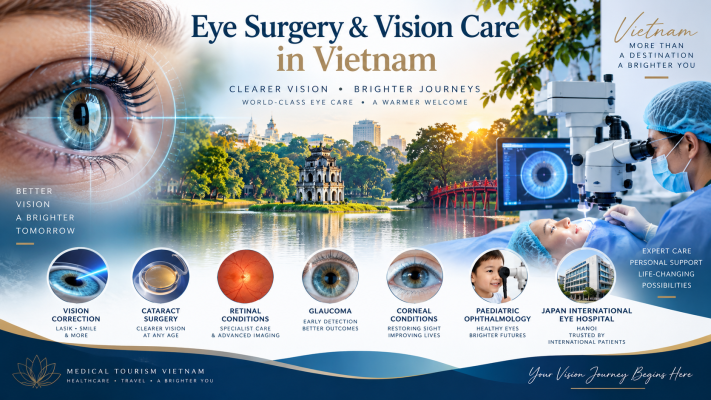
Vietnam has developed a growing range of ophthalmology services, from routine eye examinations and vision correction to cataract surgery and specialist care for retinal, corneal and glaucoma-related conditions.
Medical Tourism Vietnam provides independent information to help international patients understand available options, prepare questions for eye specialists and explore appropriate healthcare pathways in Vietnam.
Understanding Eye Care and Ophthalmology
Ophthalmology covers the diagnosis and medical or surgical treatment of conditions affecting the eyes and vision.
Some patients seek treatment because their eyesight can no longer be adequately corrected with glasses or contact lenses. Others may have cataracts, glaucoma, retinal disease, corneal conditions or other problems requiring specialist investigation.
A comprehensive assessment may include visual acuity testing, refraction, examination of the front and back of the eye, measurement of intraocular pressure and specialised imaging where clinically appropriate.
The results help an ophthalmologist determine whether treatment is necessary and, if so, which approach may be suitable.
Eye Examinations and Diagnosis
A thorough eye examination is particularly important before travelling for surgery.
Depending on the patient’s symptoms and proposed treatment, assessment may include:
- vision and refraction testing;
- corneal measurements and mapping;
- intraocular pressure measurement;
- retinal examination and imaging;
- evaluation of the optic nerve;
- assessment of the lens and cataract formation; and
- additional diagnostic investigations recommended by the ophthalmologist.
Patients should provide details of previous eye surgery, current glasses or contact-lens prescriptions, medications and relevant medical conditions.
Vision Correction
Refractive surgery is designed to reduce dependence on glasses or contact lenses by changing how light is focused within the eye.
Different procedures are available, and no single technique is appropriate for everyone. Suitability can depend on factors including age, prescription stability, corneal thickness and shape, eye health and the presence of other medical conditions.
Femtosecond LASIK
Femtosecond LASIK uses laser technology during the creation of the corneal flap before the cornea is reshaped to correct refractive error.
Patients considering LASIK require detailed pre-operative assessment to determine whether their eyes are suitable for the procedure.
Explore: Femtosecond LASIK in Vietnam
ReLEx SMILE
Small Incision Lenticule Extraction (SMILE) is another form of laser vision correction. The procedure reshapes the cornea through a small incision rather than creating the larger corneal flap associated with conventional LASIK.
The advantages and limitations of SMILE should be discussed with an ophthalmologist after appropriate diagnostic testing.
Explore: ReLEx SMILE Surgery in Vietnam
Cataract Surgery
A cataract develops when the natural lens of the eye becomes cloudy. Symptoms can include blurred or hazy vision, glare, reduced night vision and changes in colour perception.
During cataract surgery, the cloudy natural lens is removed and replaced with an artificial intraocular lens (IOL).
Different types of intraocular lenses are available. The appropriate choice depends on the patient’s eye health, visual requirements, lifestyle and the ophthalmologist’s assessment.
International patients should also discuss how soon they may safely fly after surgery and whether follow-up examinations will be required before returning home.
Retinal Conditions
The retina is the light-sensitive tissue at the back of the eye. Retinal conditions range from relatively stable disorders requiring monitoring to urgent problems that can threaten vision.
Specialist assessment may involve retinal imaging and other diagnostic investigations.
Treatment varies considerably depending on the diagnosis and may involve observation, medication, injections, laser treatment or surgery.
Patients experiencing sudden loss of vision, a sudden increase in floaters, flashing lights or a curtain-like shadow across their vision should seek urgent medical assessment rather than delay care in order to travel.
Glaucoma
Glaucoma describes a group of eye diseases that can damage the optic nerve and potentially lead to irreversible loss of vision.
Because early glaucoma may produce few noticeable symptoms, regular eye examinations can be important for people at increased risk.
Management may include monitoring, prescription eye drops, laser procedures or surgery depending on the type and severity of the condition.
Treatment is generally aimed at controlling the disease and protecting remaining vision rather than restoring vision already lost through optic-nerve damage.
Corneal Conditions
The cornea is the transparent surface at the front of the eye and plays an important role in focusing light.
Corneal disorders can arise from infection, injury, inherited conditions or progressive diseases affecting the structure of the cornea.
Treatment depends on the diagnosis and may range from medication or specialist contact lenses to surgical procedures. In selected cases, corneal transplantation may be considered.
Patients considering transplantation overseas should discuss donor-tissue availability, surgical suitability and long-term follow-up requirements with the treating specialist.
Paediatric Ophthalmology
Children can experience eye and vision problems that require specialist assessment.
Paediatric ophthalmology may include the evaluation and management of conditions such as strabismus, amblyopia, refractive errors and certain congenital or developmental eye disorders.
Early diagnosis can be particularly important because vision continues to develop during childhood.
International families considering treatment should also understand what follow-up will be required after returning home.
Oculoplastic and Reconstructive Eye Surgery
Oculoplastic surgery deals with the eyelids, tear ducts, eye socket and surrounding structures.
Procedures may be performed for functional, reconstructive or medical reasons as well as, in some circumstances, cosmetic concerns.
Patients should distinguish medically necessary ophthalmic procedures from purely cosmetic eyelid surgery and ensure that the treating specialist has appropriate expertise for their particular condition.
Choosing an Eye Specialist in Vietnam
The technology used by a hospital or eye clinic is important, but technology alone should not determine where a patient receives treatment.
International patients should consider:
- the qualifications and experience of the ophthalmologist;
- experience with the particular condition or procedure;
- the diagnostic assessment performed before treatment;
- why a particular procedure has been recommended;
- alternative treatment options;
- expected benefits and limitations;
- potential complications;
- arrangements for post-operative care; and
- what happens if a problem develops after returning home.
Patients should be cautious about choosing eye surgery primarily on the basis of price or promotional claims.
Featured Eye-Care Provider in Hanoi
Japan International Eye Hospital
Japan International Eye Hospital in Hanoi provides ophthalmology services for Vietnamese and international patients across a range of eye conditions and vision-care needs.
Its inclusion on Medical Tourism Vietnam provides patients with one potential provider to investigate when considering eye assessment or treatment in Hanoi. Inclusion does not mean that the hospital or a particular procedure will be appropriate for every patient.
Treatment decisions should be based on individual examination, diagnosis and consultation with an appropriately qualified ophthalmologist.
Explore: Japan International Eye Hospital Hanoi
Planning Travel for Eye Treatment
Eye treatment can require more planning than simply arranging the procedure and a return flight.
Depending on the treatment, patients may need to remain in Vietnam for post-operative examinations. Activities such as swimming, strenuous exercise, driving or air travel may also be temporarily restricted.
Before booking travel, ask the treating provider:
- How long should I remain in Vietnam after treatment?
- When will my first follow-up examination take place?
- When can I safely fly?
- What symptoms require urgent medical attention?
- What medications or eye drops will I need?
- What information will be provided to my doctor or eye specialist at home?
Travel arrangements should follow the treating ophthalmologist’s individual advice.
Follow-Up After Returning Home
Continuity of care is particularly important following eye surgery.
Patients should obtain copies of relevant diagnostic results, procedure details, prescribed medications and follow-up recommendations before leaving Vietnam.
Where continuing monitoring is required, arrangements should ideally be made with an optometrist or ophthalmologist in the patient’s home country.
Considering Eye Treatment in Vietnam?
Medical Tourism Vietnam can help international patients explore eye-care options in Vietnam and understand the information they may need before approaching a provider.
Depending on the enquiry, this may include assistance identifying an appropriate hospital or specialist pathway and facilitating preliminary communication with healthcare providers.
Contact Medical Tourism Vietnam
There is no obligation to proceed. Final medical suitability, treatment recommendations and quotations are determined by the treating healthcare provider following individual assessment.
Medical Disclaimer
The information on this page is provided for general educational purposes and should not be considered medical advice, diagnosis or a recommendation for any particular treatment or healthcare provider.
Suitability for eye surgery or other ophthalmic treatment can only be determined following individual assessment by an appropriately qualified healthcare professional. Treatment outcomes, recovery times and risks vary between patients and procedures.
Patients should seek professional medical advice before making decisions about treatment or international travel for healthcare.
About the Author
George Adams is the Founder and Editor of Medical Tourism Vietnam. Drawing on many years of experience living and working in Vietnam and across Asia, he develops patient-focused information designed to help international visitors better understand healthcare and medical-travel options in the region. Medical Tourism Vietnam also publishes broader healthcare, travel and Asia-focused features through Hanoi Trading Post.
Editorial Policy
Medical Tourism Vietnam aims to provide clear, balanced and patient-focused information about healthcare and medical travel. Provider inclusion does not constitute a guarantee of treatment suitability or outcome. Medical decisions remain between the patient and appropriately qualified healthcare professionals.
Last Reviewed: 8 September 2026