




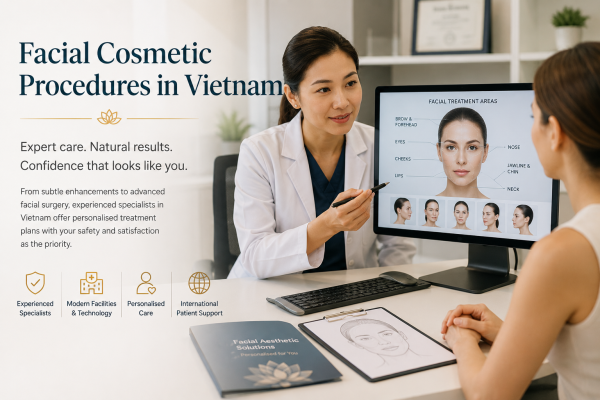
 A specialist consultation can help patients understand facial cosmetic treatment options, including procedures for the eyes, brow, nose, jawline and neck.
Facial cosmetic procedures can address concerns ranging from the early signs of ageing to changes in facial proportion, eyelid appearance, nose shape, jawline definition and skin texture.
Vietnam’s developing cosmetic and plastic surgery sector offers international patients access to a range of surgical and non-surgical facial treatments, supported by specialist clinics, hospitals and international patient services.
At Medical Tourism Vietnam, our aim is to help you understand the available options, identify the questions you should ask and, when you are ready, take the next step towards an individual consultation with an appropriate healthcare provider.
Whether you are considering a subtle change or more comprehensive facial surgery, treatment should begin with an assessment of your individual facial anatomy, health, expectations and desired outcome.
Why Consider Facial Cosmetic Treatment in Vietnam?
Vietnam has become increasingly accessible to international patients seeking cosmetic and aesthetic treatment in Asia.
For prospective patients, potential advantages may include:
- Access to experienced cosmetic and plastic surgery providers
- Modern private hospitals and specialist aesthetic facilities
- A broad range of facial procedures
- Competitive treatment costs compared with some international markets
- International patient assistance at selected providers
- Consultation and treatment options in major centres such as Hanoi and Ho Chi Minh City
- The opportunity to obtain an individual treatment plan before making final travel arrangements
Price, however, should never be the sole reason for choosing a surgeon or procedure.
The surgeon’s qualifications and experience, the standard of the facility, anaesthesia arrangements, postoperative care and management of complications are fundamental considerations.
Explore Facial Cosmetic Procedures
Different procedures address different areas of the face. Understanding those distinctions can help you identify which treatment may be worth discussing during a specialist consultation.
Brow Lift (Forehead Lift)
A brow lift is designed to reposition tissues of the forehead and brow area. It may be considered by patients concerned about a lowered brow position or changes in the upper face associated with ageing.
The procedure should not be confused with eyelid surgery, although the two may sometimes be considered together following specialist assessment.
→ Explore Brow Lift (Forehead Lift)
Eyelid Surgery (Blepharoplasty)
Blepharoplasty addresses selected changes involving the upper or lower eyelids.
Depending on the patient, treatment may involve excess skin, underlying fat or other tissues contributing to a heavy or tired appearance around the eyes.
Asian eyelid anatomy varies considerably between individuals, making personalised assessment particularly important.
→ Explore Eyelid Surgery (Blepharoplasty)
Facelift Surgery
Facelift surgery is intended to reposition and reshape selected tissues of the lower and middle face affected by ageing and tissue laxity.
Modern facelift surgery should be considered in terms of individual facial anatomy rather than simply trying to make someone “look younger.”
Some patients may also discuss neck surgery, eyelid surgery or other complementary procedures with their surgeon.
Neck Lift
A neck lift may address loose skin, tissue laxity and changes in contour around the neck and jawline.
For some patients, ageing changes affect both the lower face and neck, meaning a surgeon may discuss whether treatment of one or both areas would produce a more balanced result.
Rhinoplasty (Nose Surgery)
Rhinoplasty changes the shape, proportion or structure of the nose.
Patients may consider rhinoplasty for cosmetic reasons, functional concerns or a combination of both.
Because the nose is central to overall facial proportion, treatment planning should consider the relationship between the nose, forehead, cheeks, lips and chin rather than assessing the nose in isolation.
→ Explore Rhinoplasty in Vietnam
Cheek Implants and Facial Contouring
Cheek augmentation can be used to alter mid-face volume and projection.
Depending on the patient’s anatomy and objectives, options may include implants or other approaches to facial volume and contour.
The appropriate treatment should be determined following assessment of the entire face rather than simply selecting an implant size.
→ Explore Cheek Implants (Malarplasty)
Chin Augmentation and Genioplasty
The chin contributes significantly to facial profile and the relationship between the lower face, jaw and nose.
Treatment options may include chin implants or surgical alteration of the chin bone, depending on the patient’s anatomy and treatment goals.
A specialist assessment can help determine whether the concern relates primarily to chin projection, jaw structure or broader facial proportions.
→ Explore Chin Augmentation and Genioplasty
Ear Correction (Pinnaplasty)
Pinnaplasty, also known as otoplasty, is surgery designed to alter the shape or position of the external ears.
It may be considered where prominent or asymmetrical ears are a concern.
→ Explore Ear Correction (Pinnaplasty)
Chemical Peels
Chemical peels use selected chemical solutions to remove controlled layers of skin.
Different types and strengths of peel may be used to address concerns such as skin texture, pigmentation or signs of sun damage.
The appropriate depth and formulation should be selected according to skin type and individual treatment goals.
Dermabrasion
Dermabrasion is a skin-resurfacing technique designed to remove controlled layers of the skin.
It may be considered for selected scars, irregularities or skin-texture concerns.
Suitability depends considerably on skin type, the condition being treated and the depth of treatment proposed.
V-Line and Facial Contouring
Facial contouring procedures may aim to alter the proportions of the lower face, chin or jawline.
Some approaches commonly associated with Asian aesthetic surgery involve modification of the jaw or chin to create a narrower or differently proportioned lower face.
These can involve significant surgery and require careful assessment of facial structure, dental relationships, nerves and underlying bone.
→ Explore V-Line Facial Contouring
Surgical vs Non-Surgical Facial Treatment
Not every facial concern requires surgery.
Surgical procedures can produce structural changes by repositioning, removing or augmenting tissue. They also involve anaesthesia, recovery, scars and surgical risks.
Non-surgical aesthetic treatments may be appropriate for some concerns involving skin quality, pigmentation, fine lines or facial volume.
The important question is not simply:
“Which treatment is most popular?”
It is:
“Which treatment, if any, is appropriate for what I want to change?”
A responsible provider should also be prepared to tell a patient when a requested procedure is unlikely to produce the desired result.
Choosing the Right Facial Procedure
It is common for patients to begin their research believing they need one procedure and discover during consultation that their concern originates somewhere else.
For example:
- Heavy upper eyelids may sometimes be influenced by brow position.
- A poorly defined jawline may involve both the lower face and neck.
- Perceived nose prominence may partly reflect chin projection.
- Facial ageing may involve skin, underlying tissue and volume changes rather than a single feature.
This is why comprehensive facial assessment is valuable.
The goal should be facial balance and an outcome appropriate to the individual, rather than attempting to reproduce another person’s appearance.
Combining Facial Procedures
Some facial procedures may be performed together where medically appropriate.
Examples might include:
- Facelift with neck lift
- Brow lift with eyelid surgery
- Facelift with eyelid surgery
- Rhinoplasty with chin augmentation
- Facial surgery combined with selected skin treatments
Combining procedures may offer advantages in selected cases, but more surgery can also mean longer operating times, greater recovery requirements and additional risk.
Whether procedures should be combined or staged should therefore be determined primarily by patient safety and clinical suitability, not convenience.
Consultation and Facial Assessment
A specialist consultation should form the basis of treatment planning.
Assessment may consider:
- General health and medical history
- Previous facial procedures
- Medications and supplements
- Smoking
- Skin condition and elasticity
- Facial structure and proportions
- Facial symmetry
- Areas of concern
- Expectations
- Scarring
- Anaesthesia
- Recovery
- Potential complications
Photographs or imaging may also be used as part of assessment and treatment planning.
Patients should understand what a procedure can realistically change — and what it cannot.
Natural-Looking Results and Realistic Expectations
Good facial cosmetic surgery should not be defined simply by how dramatic the change appears.
Many patients seek an outcome that improves a particular concern while retaining their individual facial characteristics.
Age, anatomy, ethnicity, skin quality, bone structure and personal preferences all influence what may constitute an appropriate result.
No ethical surgeon can guarantee a particular cosmetic outcome.
Before-and-after photographs can be useful when discussing a surgeon’s work, but another patient’s result should never be interpreted as a guarantee of your own.
Choosing a Facial Cosmetic Surgeon in Vietnam
For an international patient, choosing the provider is as important as choosing the procedure.
Questions worth considering include:
- Is the surgeon appropriately qualified?
- Does the surgeon regularly perform the procedure you are considering?
- Where will the procedure take place?
- Is the facility appropriately equipped?
- Who will administer the anaesthetic?
- What preoperative assessment is required?
- What happens if a complication occurs?
- What postoperative care is provided?
- How long should you remain in Vietnam?
- What follow-up is available after you return home?
For procedures involving significant facial bone modification, patients should also understand the surgeon’s specific experience with that type of surgery.
Planning Cosmetic Surgery in Vietnam
International patients should think of treatment as a patient journey, not simply an operation.
A typical pathway may involve:
Initial enquiry → preliminary information → provider assessment → consultation → proposed treatment plan and quotation → travel planning → in-person assessment → treatment → recovery → postoperative review → return home → follow-up
The exact pathway depends on the procedure and provider.
Whenever possible, international patients should understand the expected recovery period before booking inflexible return travel.
Considering Facial Cosmetic Treatment in Vietnam?
If you are exploring facial cosmetic surgery or aesthetic treatment in Vietnam, Medical Tourism Vietnam can help you take the next step.
You may not yet know precisely which procedure is appropriate. That is perfectly reasonable.
We can assist with preliminary enquiries and help obtain information from suitable healthcare providers regarding:
- Available facial procedures
- Specialist consultations
- Treatment options
- Indicative costs
- Expected length of stay
- International patient arrangements
- Appointment availability
- Preliminary provider assessment where available
Enquire About Facial Cosmetic Treatment in Vietnam
There is no obligation to proceed. Final medical suitability, treatment recommendations and quotations are determined by the treating healthcare provider following individual assessment.
Explore More Cosmetic Surgery Options
From this hub I would also link to:
- Cosmetic Surgery in Vietnam
- Breast Augmentation in Vietnam
- Breast Lift Surgery in Vietnam
- Breast Reduction Surgery in Vietnam
- Abdominoplasty in Vietnam
- Liposuction in Vietnam
- Gluteal Augmentation in Vietnam
- Kangnam Aesthetic Hospital Hanoi
Medical Disclaimer
The information provided on this page is for general educational purposes only and does not constitute medical advice, diagnosis or a recommendation for treatment.
Cosmetic procedures vary considerably in complexity and risk. Suitability, treatment options, expected outcomes and recovery depend on individual circumstances. Anyone considering treatment should obtain an individual assessment from an appropriately qualified healthcare professional and understand the potential benefits, limitations and risks before proceeding.
About the Author
George Adams is the founder and editor of Medical Tourism Vietnam and Hanoi Trading Post. He writes on healthcare, medical tourism and developments in specialist medical treatment across Asia.
Editorial Policy
Medical Tourism Vietnam publishes patient-focused educational information intended to help international patients better understand healthcare and treatment options. Provider information, where included, is presented in an educational context and does not constitute a guarantee of suitability or treatment outcome.
Last Reviewed
28 August 2026