




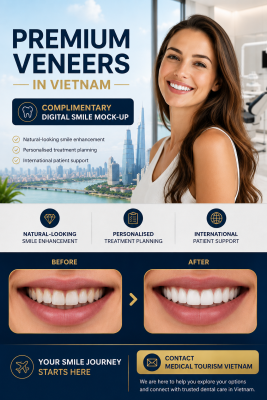
Premium Veneers in Vietnam
A Patient-First Guide to Cosmetic Dentistry and Smile Design
Vietnam has become an increasingly attractive destination for international patients considering cosmetic dentistry, including porcelain, E.max and composite veneers. Modern dental clinics, digital treatment planning and competitive treatment costs can make Vietnam worth considering for patients seeking to improve the appearance of their smile.
However, veneers are not appropriate for every patient or every cosmetic concern.
At Medical Tourism Vietnam, we believe the starting point should be a careful assessment of your oral health, existing teeth, bite and treatment goals. The objective should be a natural-looking result achieved through appropriate treatment planning while preserving healthy natural tooth structure wherever possible.
What Are Dental Veneers?
Dental veneers are thin restorations placed over the visible surface of teeth to change their appearance. Depending on the individual patient, veneers may be considered for concerns such as tooth colour, shape, minor spacing, worn or chipped teeth, uneven proportions or smile symmetry.
Veneers can produce significant cosmetic changes, but they should not be viewed simply as a beauty treatment. They are part of dentistry and should be planned and performed by appropriately qualified dental professionals.
The first question should not be “Which veneer should I choose?” but “Are veneers the right treatment for my teeth?”
Are Veneers Right for You?
Suitability for veneers depends on more than the appearance of your smile.
Before recommending treatment, a dentist may need to assess the health of your teeth and gums, existing fillings or restorations, available tooth structure, bite, tooth alignment, signs of grinding or clenching, and your expectations for treatment.
Untreated tooth decay, gum disease or other oral-health problems may need attention before cosmetic treatment begins.
Some patients who initially enquire about veneers may discover that another treatment—or a combination of treatments—is more appropriate.
A proper dental assessment should therefore come before the final cosmetic decision.
Alternatives to Veneers
Veneers are only one way of changing a smile.
Depending on the condition of your teeth and what you hope to achieve, alternatives may include:
- professional teeth whitening;
- orthodontic treatment to improve tooth position;
- composite bonding for selected cosmetic concerns;
- restorative dental treatment; or
- dental crowns where greater restoration of a damaged tooth is clinically appropriate.
In some cases, a relatively conservative treatment may achieve the patient’s objective without extensive restoration of otherwise healthy teeth.
Good cosmetic dentistry is not about placing veneers on as many teeth as possible. It is about selecting the most appropriate treatment while preserving healthy natural tooth structure wherever possible.
Types of Dental Veneers
Porcelain Veneers
Porcelain veneers are individually fabricated restorations designed to reproduce the colour, translucency and proportions of natural teeth.
They can provide a highly aesthetic result and good resistance to staining, but their suitability depends on the individual tooth, bite, preparation required and overall treatment plan.
E.max Veneers
E.max is a lithium-disilicate ceramic commonly used in aesthetic dentistry. Its optical characteristics can allow dentists and dental laboratories to create natural-looking restorations with varying degrees of translucency.
E.max should not automatically be regarded as the “best” material for every patient. The appropriate material should be selected according to the clinical situation, aesthetic objectives, tooth structure and professional judgement of the treating dentist.
Composite Veneers
Composite veneers use tooth-coloured resin that can be shaped directly on the teeth or prepared through an indirect process.
In appropriate cases, composite treatment may require less alteration of the natural tooth and can sometimes be completed more quickly than laboratory-made ceramic veneers.
Composite and ceramic restorations have different characteristics in relation to appearance, staining, wear, repair and longevity. These differences should be discussed with the dentist before treatment is selected.
Digital Smile Design & Smile Mock-Ups
Digital technology has become an important part of modern cosmetic dentistry.
Depending on the clinic and treatment, planning may involve digital photographs, intraoral scans, dental imaging, smile analysis, shade selection and computer-assisted simulations.
A digital smile design or mock-up can help patients and dentists discuss tooth shape, proportion and the overall appearance of the proposed smile before definitive treatment begins.
This can be particularly useful for international patients because expectations can be discussed before substantial treatment is undertaken.
A digital smile simulation is a planning and communication tool. It can help a patient discuss preferences with the dentist, but it should not be interpreted as a guarantee of the final clinical result.
Understanding Tooth Preparation
One of the most important questions to ask before choosing veneers is how much natural tooth structure will need to be altered.
Some veneer treatments require removal of a small amount of enamel so that the restoration can be positioned correctly. The amount of preparation varies according to the patient’s teeth, tooth position, proposed material and treatment plan.
More conservative approaches may be possible in selected cases, but terms such as “minimal preparation” or “no-prep veneers” should not be assumed to be suitable for everyone.
A useful question to ask your dentist is:
How much natural tooth structure will be removed, and why?
Patients should understand the implications before consenting to treatment. Where natural tooth structure is removed, treatment may not be fully reversible.
What Does Veneer Treatment Involve?
Every case is different, but an international patient’s treatment pathway may include:
Initial enquiry → photographs or dental records → preliminary information → dental examination → imaging or digital scanning where required → treatment planning → smile design or mock-up → tooth preparation where required → veneer fabrication → fitting → bite adjustment → follow-up
Preliminary information supplied before travel can be useful, particularly when photographs, dental X-rays or previous treatment records are available.
However, a preliminary opinion or quotation should not be treated as the final treatment plan.
The dentist may need to examine the teeth and gums personally before confirming suitability, the number of teeth requiring treatment, the material to be used and the final cost.
For more information about how we support patients before treatment, see our International Patient Process & Support Services.
Risks, Longevity & Future Maintenance
Veneers should be considered a long-term dental commitment rather than simply a short-term cosmetic procedure.
Possible problems can include tooth sensitivity, chipping, fracture, debonding, changes around the gum line, bite-related problems or the need for future repair or replacement.
Ceramic restorations are designed to be durable, but they are not indestructible. Longevity varies between patients and can be influenced by the condition of the underlying teeth, bite forces, grinding or clenching, oral hygiene, material selection and ongoing dental care.
Patients should therefore ask not only:
“How will my veneers look?”
but also:
“How will these teeth be maintained over the years?”
For international patients, follow-up is particularly important. Before travelling home, ask the clinic what follow-up is recommended and what arrangements apply if a veneer requires adjustment, repair or replacement later.
Choosing a Dental Clinic in Vietnam
Choosing a provider should involve more than comparing photographs and prices.
International patients considering veneers may wish to ask about:
- the dentist’s qualifications and experience in cosmetic and restorative dentistry;
- how the clinic assesses oral health before cosmetic treatment;
- diagnostic imaging and digital treatment-planning facilities;
- the materials proposed and why they are recommended;
- dental laboratory arrangements;
- infection-control procedures;
- how much natural tooth structure is expected to be removed;
- opportunities to review the proposed smile before final treatment;
- communication during treatment;
- follow-up arrangements; and
- what happens if a problem develops after returning home.
Before-and-after photographs can help demonstrate a dentist’s aesthetic style, but they cannot predict the result for another patient.
Price should be considered alongside clinical suitability, provider experience, materials, treatment planning and follow-up—not in isolation.
For a broader overview of treatment options, visit Dental Care in Vietnam.
Why Consider Vietnam for Veneers?
For international patients, Vietnam can offer an attractive combination of modern dental care, experienced practitioners, developing digital dentistry and competitive treatment costs.
Quality. Cost. Convenience.
Quality means looking beyond the appearance of the clinic to the dentist’s qualifications, diagnostic process, treatment planning, materials, laboratory standards and follow-up.
Cost matters, particularly when cosmetic dental treatment involves several teeth. However, patients should compare what is included in quotations rather than simply comparing headline prices.
Convenience includes communication, appointment scheduling, treatment time, laboratory requirements, accommodation, travel and the practical arrangements needed before returning home.
Cheap dentistry is not our objective. Better-value access to appropriate, high-quality dental care is.
Patients researching Vietnam more broadly may also find our Why Vietnam for Medical Tourism guide useful.
Treatment First. Travel Second.
Vietnam offers much to experience as a destination, but dental treatment should not be forced into a predetermined holiday schedule.
Assessment, treatment planning, laboratory fabrication, fitting, bite adjustment and follow-up can all require time.
Patients considering veneers should understand the proposed treatment schedule before booking flights or making non-refundable travel arrangements.
The treatment should determine the itinerary. The itinerary should never determine the treatment.
Our International Patient Process & Support Services explains the broader patient journey.
Dental Care in Hanoi and Ho Chi Minh City
Vietnam’s two largest cities offer international patients a wide range of dental clinics and treatment options.
Patients considering treatment in northern Vietnam can learn more in our Dental Care in Hanoi guide.
Patients considering treatment in southern Vietnam can visit Dental Care in Ho Chi Minh City.
A Provider Pathway in Hanoi
Medical Tourism Vietnam has an established collaboration with TrendSmile Dental Hanoi, providing one pathway for international patients exploring veneers and other forms of cosmetic dentistry in Hanoi.
Depending on the individual enquiry, patients may be able to submit dental information or photographs for preliminary review and discuss available treatment options before deciding whether to proceed.
Read more about the Medical Tourism Vietnam and TrendSmile Dental Hanoi partnership.
A provider relationship does not mean that a particular clinic or treatment is suitable for every patient.
Patients remain free to compare providers, treatment plans and quotations before deciding whether to proceed.
Final clinical suitability and treatment recommendations remain the responsibility of the treating dental professional following individual assessment.
Selected Patient Offers
From time to time, participating dental clinics and healthcare providers may make special offers or preferred arrangements available to eligible international patients who enquire through Medical Tourism Vietnam.
Depending on the provider, these may include an initial consultation or case review, preliminary review of dental records, digital smile assessment, preferred treatment arrangements or another provider-specific benefit.
Not every offer includes the same services, and availability and eligibility may change.
Most importantly, a patient offer should never determine where a patient receives dental treatment. Clinical suitability, provider experience, the proposed treatment, follow-up and overall cost should all be considered before making a decision.
There is no charge to patients for making an initial enquiry or receiving information about available patient offers.
How Medical Tourism Vietnam Can Help
Choosing dental treatment in another country can involve many decisions before a patient ever enters a clinic.
Medical Tourism Vietnam provides a patient-first starting point for international patients researching dental care in Vietnam.
Depending on your enquiry, we may help you:
- identify potential dental providers;
- communicate initial questions;
- submit photographs, dental imaging or other relevant information for preliminary review;
- request treatment information and quotations;
- ask about current Selected Patient Offers;
- compare available treatment pathways;
- arrange appointments; and
- understand practical aspects of travelling to Vietnam for dental treatment.
Where appropriate, patients may consider information or quotations from more than one provider.
Medical Tourism Vietnam may have commercial or referral relationships with participating healthcare providers. These relationships help support our services but do not remove the patient’s right to consider alternative providers or decide not to proceed.
Medical Tourism Vietnam does not diagnose dental conditions, determine clinical suitability or provide dental treatment. Clinical decisions remain between the patient and the treating dental professional.
Learn more about How Medical Tourism Vietnam Works.
Considering Premium Veneers in Vietnam?
If you are considering porcelain, E.max or composite veneers in Vietnam, Medical Tourism Vietnam can help you explore treatment pathways, communicate with participating dental providers, request preliminary information or quotations and check whether a current Selected Patient Offer may be available.
There is no charge for making an initial patient enquiry or receiving information about available patient offers. There is no obligation to proceed.
Book an appointment or contact us for confidential assistance.
Final clinical suitability, treatment recommendations, risks, expected outcomes and quotations are determined by the treating dental provider following individual assessment.
About Medical Tourism Vietnam
Medical Tourism Vietnam provides educational information and practical support for international patients researching healthcare in Vietnam and selected destinations across Asia.
Our patient-first approach is designed to help people understand their options, ask appropriate questions and make informed decisions before committing to treatment or travel.
Learn more About Medical Tourism Vietnam and about How Medical Tourism Vietnam Works.
Medical & Dental Disclaimer
Information published by Medical Tourism Vietnam is provided for general educational and informational purposes only and does not constitute individual medical or dental advice.
Medical Tourism Vietnam does not diagnose dental or medical conditions, determine treatment suitability, prescribe treatment or guarantee treatment outcomes.
Dental veneers and other cosmetic dental procedures should be assessed, planned and performed by appropriately qualified dental professionals. Individual risks, benefits, alternatives, expected outcomes, treatment requirements and costs vary between patients.
Patients should obtain appropriate professional dental advice and ensure that they understand the proposed treatment, alternatives, risks, follow-up requirements and costs before deciding whether to proceed.
Last Reviewed: October 2026