





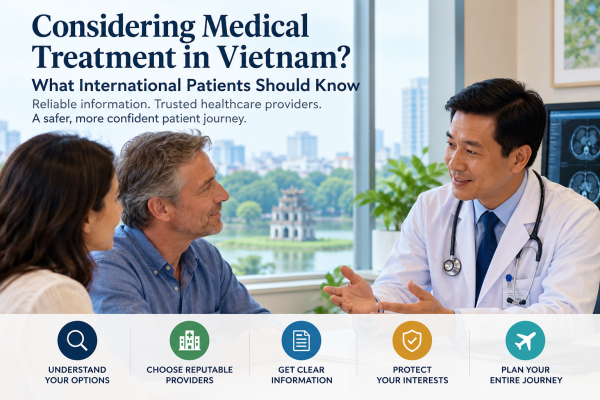
Considering Medical Treatment in Vietnam? What International Patients Should Know
An international patient’s guide to choosing healthcare providers, understanding treatment costs, planning recovery and protecting your interests when seeking medical care in Vietnam.
Vietnam is attracting increasing international attention as a destination for medical treatment. From dentistry and cosmetic surgery to fertility services, diagnostic investigations and selected advanced surgical procedures, the country’s healthcare sector offers opportunities for patients exploring treatment outside their home country.
But choosing medical treatment overseas is an important decision. Competitive prices, modern hospitals and attractive destinations are only part of the picture.
The most important questions concern the suitability of the treatment, the qualifications of the medical team, patient safety and what happens after you return home.
At Medical Tourism Vietnam, established in 2011, we believe international healthcare decisions should begin with reliable information and informed patient choice—not a predetermined treatment package.
This guide explains what patients should consider before travelling to Vietnam for medical care.
Why Are International Patients Considering Vietnam?
Vietnam’s healthcare capabilities have developed considerably over recent years.
A recent VietNamNet report, “Why foreigners are crossing oceans for medical treatment in Vietnam”, highlights international patients seeking advanced medical services in Vietnamese hospitals, including robotic surgery and complex specialist procedures.
These developments demonstrate that Vietnam’s international healthcare appeal extends beyond traditional elective treatments.
Patients may consider Vietnam for several reasons:
- Access to experienced medical and dental specialists.
- Potentially competitive treatment costs.
- Modern diagnostic equipment and surgical technology at selected facilities.
- Opportunities to obtain specialist consultations and treatment without lengthy delays, depending on the provider.
- Established international transport connections.
- Accommodation and extended-stay options for patients who require recovery time before returning home.
However, not every hospital provides the same services, and the availability of advanced equipment does not necessarily establish the quality or suitability of treatment.
Patients should evaluate individual providers and specialists rather than rely on general claims about a country’s healthcare system.
1. Choosing a Hospital or Medical Specialist in Vietnam
Selecting an appropriate healthcare provider is one of the most important decisions in medical travel.
A modern hospital building, impressive website or sophisticated piece of equipment is not sufficient evidence of clinical quality.
Before committing to treatment, patients should seek information about the hospital’s licensing, the treating doctor’s professional qualifications, relevant specialist experience and the availability of appropriate facilities.
International accreditation may provide useful additional information, but accreditation alone does not guarantee a particular treatment outcome.
Patients should also ask whether the proposed procedure is routinely performed at the facility and whether appropriate emergency and intensive-care support is available when required.
Questions worth asking
- Who will be responsible for my diagnosis and treatment?
- What qualifications and relevant experience does the treating specialist hold?
- Is the hospital appropriately licensed for the proposed service?
- What are the expected benefits, risks and reasonable alternatives?
- What arrangements exist for complications or unexpected hospital admissions?
- Will I receive copies of my medical records and discharge documentation?
Patients should be encouraged to ask questions and obtain clarification before agreeing to treatment.
A reputable provider should welcome informed questions rather than pressure patients into making immediate decisions.
2. Obtain a Medical Assessment Before Making Travel Arrangements
One of the most common mistakes in medical tourism is arranging flights and accommodation before establishing whether the proposed treatment is appropriate.
Where possible, patients should first provide relevant medical records for review by a qualified healthcare professional.
Depending on the treatment, these may include medical histories, diagnostic imaging, laboratory results, specialist reports, medication lists and previous treatment records.
The hospital may then provide a preliminary assessment and explain whether additional investigations or an in-person consultation will be necessary.
A preliminary opinion does not replace a complete medical examination.
The final treatment recommendation may change after further investigations.
This is particularly important for patients considering major surgery, complex dental reconstruction, fertility treatment or specialist medical interventions.
The treatment should determine the travel arrangements—not the other way around.
3. Understand the Full Cost of Medical Treatment
Cost is an important consideration for many international patients.
Vietnam may offer financial advantages for selected medical and dental procedures, but advertised prices should never be treated as guaranteed final treatment costs.
A quotation should explain, wherever reasonably possible, what is included and what may be charged separately.
Patients should request information about:
- Specialist consultation and professional fees.
- Diagnostic tests and preoperative investigations.
- Hospital accommodation and operating theatre charges.
- Anaesthesia, medicines, implants and medical consumables.
- Expected hospital admission and discharge arrangements.
- Postoperative reviews and necessary follow-up appointments.
- Additional charges if complications arise or hospitalisation is extended.
Where treatment plans differ between providers, patients should compare the clinical recommendations and inclusions—not simply the headline prices.
A lower quotation is not necessarily better value if important services have been excluded.
Medical Tourism Vietnam encourages patients to obtain and compare appropriate provider quotations before deciding how to proceed.
4. Patient Safety, Informed Consent and Medical Risks
All medical procedures involve potential risks.
These may include infection, bleeding, adverse reactions, unexpected complications or the possibility that the desired treatment outcome will not be achieved.
The nature and likelihood of these risks depend on the patient’s health, the proposed procedure and other clinical factors.
Before treatment, patients should receive an understandable explanation of the diagnosis, proposed intervention, potential benefits, material risks and available alternatives.
They should also understand what could happen if they decide not to proceed.
Language should not become an obstacle to informed consent.
Where necessary, patients should ask whether qualified medical interpretation or appropriate language support is available.
Patients should never feel obliged to proceed with treatment simply because they have already travelled internationally or paid for accommodation.
5. Recovery and Extended-Stay Planning
Recovery arrangements are particularly important for patients travelling overseas.
Depending on the procedure, a patient may require additional time in Vietnam after leaving hospital.
This can involve postoperative consultations, wound assessment, rehabilitation, medication management or further investigations.
For some patients, a hotel or serviced apartment may be appropriate after clinical discharge. Others may require supervised rehabilitation, nursing support or accommodation with easier access to their treating hospital.
Recovery should not be confused with a holiday.
Long journeys, strenuous activities, swimming, alcohol consumption and certain forms of sightseeing may be unsuitable during recovery.
The treating clinician should advise when these activities and air travel can safely resume.
Patients should also consider the possibility of unexpected delays before booking non-refundable return flights.
Choosing a destination for treatment and recovery
Vietnam offers several established healthcare and visitor destinations.
Hanoi provides access to major hospitals, specialist services and accommodation options in the capital.
[Ho Chi Minh City is another major healthcare centre with public and private medical facilities serving local and international patients.Da Nang may appeal to patients considering suitable healthcare services alongside a quieter coastal environment, provided the necessary medical support is available.
Patients should select their healthcare provider first and then consider whether the destination and accommodation arrangements are appropriate for their treatment and recovery needs.
For broader regional destination information, Glowcations Asia explores healthcare, destinations and extended-stay opportunities across Asia.
6. Continuity of Care: What Happens When You Return Home?
Medical treatment does not necessarily end when a patient leaves hospital.
Following surgery or other significant medical interventions, patients may require ongoing reviews, medication adjustments, rehabilitation or monitoring.
Before returning home, patients should establish who will be responsible for follow-up care and how information will be shared between their Vietnamese medical team and healthcare professionals in their home country.
Important arrangements may include:
- A discharge summary and copies of relevant medical records.
- Clear medication instructions.
- Details of any implants or devices used.
- Recommended follow-up investigations and their timing.
- Contact information for the treating hospital.
- Instructions about symptoms that require urgent medical attention.
- A plan for communicating with the Vietnamese specialist if complications or questions arise.
Patients should also consider whether their regular doctor or an appropriate specialist at home is willing and able to provide the necessary follow-up care.
This should ideally be discussed before travelling.
Continuity of care is not an optional extra. It is an essential part of responsible international healthcare.
7. Understanding the Role of Medical Tourism Vietnam
Established in 2011, Medical Tourism Vietnam provides information and coordination support for international patients exploring healthcare options in Vietnam.
Our approach is based on informed choice, transparent information and communication with appropriate healthcare providers.
We do not provide medical diagnoses, prescribe treatment or make clinical decisions on behalf of patients.
Those responsibilities remain with qualified medical professionals and the patient.
Depending on the enquiry and available provider services, our role may include helping patients identify suitable healthcare providers, facilitating initial communication, requesting treatment information and quotations, and explaining practical considerations surrounding travel and recovery.
We do not require patients to purchase predetermined combinations of medical treatment, accommodation and tourism services.
Patients should remain free to consider appropriate alternatives and decide whether to proceed.
Medical Tourism Vietnam may receive a referral commission from participating healthcare providers when a patient proceeds with treatment. This commercial arrangement should not replace transparent information or the patient’s freedom to choose.
Our objective is to support a more informed and practical international healthcare journey.
8. Vietnam’s Growing International Healthcare Reputation
Vietnam’s developing medical capabilities deserve recognition.
However, international patient confidence must be earned through consistent clinical standards, responsible communication and reliable follow-up arrangements.
This broader issue was examined in our independent Hanoi Trading Post editorial, “Vietnam’s Medical Tourism Opportunity: International Recognition Must Be Matched by Patient Trust”.
The article considers why Vietnam’s international healthcare development should be measured not only by the number of overseas patients attracted, but also by patient safety, transparency and the quality of care provided.
For prospective patients, the underlying message is straightforward.
Vietnam may offer worthwhile medical treatment opportunities, but the decision should always be based on individual medical needs and careful evaluation of the available options.
9. Before You Travel: A Final Patient Checklist
Before committing to medical treatment in Vietnam, make sure you can answer the following questions.
Medical suitability: Has an appropriately qualified clinician reviewed my condition and explained the proposed treatment?
Provider qualifications: Have I checked the hospital’s licensing and the treating specialist’s credentials?
Treatment information: Do I understand the expected benefits, risks, alternatives and possible complications?
Financial arrangements: Have I received a sufficiently detailed quotation, including significant exclusions and potential additional costs?
Travel arrangements: Have I discussed my fitness to travel and expected recovery period with my treating clinician?
Insurance: Have I checked whether my travel or medical insurance covers planned treatment abroad and related complications? Many ordinary travel insurance policies exclude elective treatment and its consequences.
Follow-up care: Do I know who will provide medical support after I return home?
Patient choice: Have I had sufficient time to consider alternatives and make my own decision?
If important questions remain unanswered, it may be better to obtain further information before making travel commitments.
Start Your Medical Treatment Enquiry with Confidence
Considering medical or dental treatment in Vietnam?
Medical Tourism Vietnam can help you begin by exploring relevant healthcare providers, requesting information and understanding the practical steps involved in seeking treatment overseas.
Whether you are considering dental care, elective surgery, specialist consultations or another healthcare service, the first step should be an informed discussion about your individual requirements.
Visit Medical Tourism Vietnam to explore our healthcare information and destination guides, or use the website’s Contact Us section to begin an enquiry.
Your healthcare comes first. Your travel arrangements should support it.
About the Author
George Adams | Founder, Medical Tourism Vietnam
George Adams founded Medical Tourism Vietnam in 2011 and has been involved in promoting informed international patient access to healthcare services in Vietnam for more than a decade.
Through Medical Tourism Vietnam and Hanoi Trading Post, he advocates transparent healthcare information, responsible provider selection, patient safety and continuity of care.
His work focuses on helping international patients understand their options and make informed decisions when considering treatment overseas.
George Adams is not a medical practitioner. Medical treatment decisions remain the responsibility of appropriately qualified healthcare professionals and individual patients.
Medical disclaimer: This article provides general educational information and is not a substitute for individual medical advice. Treatment suitability, clinical risks, travel fitness and follow-up requirements must be assessed by appropriately qualified healthcare professionals. Medical Tourism Vietnam is an information and patient coordination service, not a healthcare provider.
