




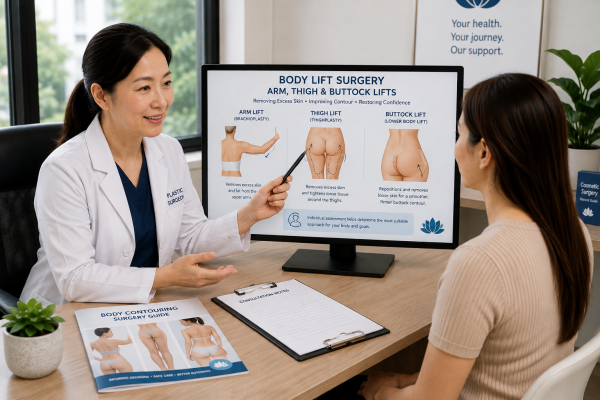
Changes following significant weight loss, ageing, pregnancy or fluctuations in body weight can leave loose skin around areas such as the upper arms, thighs and buttocks. Exercise can improve muscle tone, but it cannot always address skin that has lost significant elasticity.
For international patients considering body lift surgery in Vietnam, understanding the differences between arm, thigh and buttock lift procedures — as well as their scars, recovery requirements and potential risks — is an important part of making an informed decision.
What Is Body Lift Surgery?
Body lift surgery is a broad term covering procedures that remove and reposition excess skin and underlying tissue to improve body contour.
Depending on the patient’s needs, treatment may involve one particular area or a combination of procedures.
The procedures covered in this guide are:
- Arm lift (brachioplasty)
- Thigh lift (thighplasty)
- Buttock lift
These operations are primarily intended to address loose or excess skin and tissue, rather than serve as weight-loss procedures.
Liposuction may sometimes be incorporated when localised excess fat is also present, but it performs a different function.
Arm Lift (Brachioplasty)
An arm lift, medically known as brachioplasty, is designed to reshape the upper arm by removing excess skin and, where appropriate, excess fatty tissue.
Loose upper-arm skin may develop following substantial weight loss or as skin elasticity changes with age.
Depending on the amount of excess tissue, an incision may extend along part or much of the inner or back portion of the upper arm. In less extensive cases, a shorter incision may be possible.
The surgeon may also use liposuction when localised fat contributes to the contour of the upper arm.
Because brachioplasty produces a permanent scar, patients should discuss its expected position and length during their consultation.
Thigh Lift
A thigh lift, sometimes called thighplasty, removes excess skin and reshapes tissue around the thighs.
The procedure may be considered following significant weight loss or when loose skin persists despite a stable body weight.
Different approaches can be used depending on where the excess skin is located.
An inner or medial thigh lift primarily addresses loose tissue around the inner thigh, while more extensive procedures may address additional areas of the upper leg.
Incision placement and scar length vary considerably according to the amount and location of tissue being removed.
Buttock Lift
A buttock lift is designed to improve the contour of the buttocks by removing excess loose skin and repositioning underlying tissue.
It may be considered when significant weight loss or changes in skin elasticity have resulted in sagging or redundant tissue around the buttocks.
A buttock lift should not be confused with procedures intended primarily to increase buttock volume.
The objective of a buttock lift is generally to remove and reposition loose tissue rather than enlarge the buttocks.
Buttock Lift vs Gluteal Augmentation
These procedures address different concerns.
Buttock lift:
Removes and repositions excess loose skin and tissue to improve contour.
Gluteal augmentation:
Aims primarily to increase or alter buttock volume and shape.
Patients sometimes use the terms interchangeably when researching cosmetic surgery, but they are different procedures with different techniques, risks and treatment goals.
We will retain Gluteal Augmentation as a separate MTV guide.
Who May Consider Body Lift Surgery?
Body-contouring procedures may be considered by adults who have loose or excess skin around particular areas of the body and are otherwise appropriate candidates for elective surgery.
Potential candidates may include people who:
- Have experienced significant weight loss
- Have maintained a relatively stable weight
- Have loose skin affecting comfort, movement or clothing
- Have age-related loss of skin elasticity
- Understand that surgery will produce permanent scars
- Have realistic expectations about the outcome
Overall health, previous surgery, medications, smoking status and other individual factors can influence suitability and surgical risk.
An appropriately qualified plastic surgeon should determine whether a particular procedure is suitable following individual assessment.
Body Lift Surgery After Significant Weight Loss
Body-contouring surgery is frequently considered after substantial weight loss.
Although weight reduction can produce major health and lifestyle benefits, skin that has been stretched for a prolonged period may not fully contract to the body’s new shape.
This can leave folds or areas of excess skin around the:
- Abdomen
- Upper arms
- Thighs
- Buttocks
- Breasts
- Torso
Some patients therefore consider more than one body-contouring procedure.
However, multiple operations should not automatically be performed at the same time. The extent and timing of surgery need to take account of the patient’s health, recovery requirements and overall surgical risk.
Body Lift vs Liposuction
Body lift procedures and liposuction address different problems.
Liposuction primarily removes localised deposits of fat.
Body lift surgery primarily removes and repositions excess skin and tissue.
A person with good skin elasticity and localised excess fat may potentially benefit from liposuction without requiring substantial skin removal.
Conversely, removing fat alone may not correct significant loose skin.
In selected patients, surgeons may combine liposuction with a lifting procedure to address both fat distribution and skin laxity.
Consultation and Assessment
A comprehensive consultation should take place before deciding on surgery.
The surgeon may assess:
- General health and medical history
- Previous operations
- Current medications and supplements
- Smoking and alcohol use
- Weight history and stability
- Amount and location of excess skin
- Skin quality and elasticity
- Distribution of underlying fat
- Existing scars
- Personal goals and expectations
The consultation should also include a clear discussion about where surgical scars are likely to be located.
For international patients, postoperative care, length of stay and arrangements following return home should form part of the planning process.
Preparing for Surgery
Preparation depends on the individual patient and the extent of the proposed surgery.
Patients may require medical assessment or investigations before surgery.
The surgical team should also be informed about all prescribed medicines, over-the-counter medicines and supplements being taken.
Smoking is particularly relevant because it can impair blood supply and wound healing and increase the risk of complications.
Patients should not stop prescribed medicines independently. Any changes should be discussed with the treating surgeon or appropriate medical practitioner.
Recovery After Body Lift Surgery
Recovery varies substantially according to which procedure is performed and whether more than one area is treated.
During the early recovery period, patients may experience:
- Swelling
- Bruising
- Discomfort
- Tightness around the operated area
- Temporary changes in sensation
- Reduced mobility
Dressings and compression garments may be recommended. Temporary drains may also be used following some procedures.
Patients should follow their surgical team’s instructions concerning wound care, bathing, activity, compression garments and follow-up appointments.
Return to work, driving, exercise and other activities should be based on individual recovery and medical advice rather than a predetermined timetable.
Scarring
Scarring is an important consideration with arm, thigh and buttock lift surgery.
Removing substantial amounts of loose skin requires surgical incisions, and the resulting scars are permanent.
Scar position varies according to the procedure.
An arm-lift scar may extend along the inner or back portion of the upper arm.
Thigh-lift scars may be located around the groin crease and, for more extensive procedures, may extend further along the thigh.
Buttock-lift scars are generally positioned so they can be concealed as much as reasonably possible beneath clothing.
Scars usually change and mature over time but will not disappear completely.
Patients should understand the likely scar pattern before consenting to surgery.
Can Procedures Be Combined?
Some patients may be candidates for more than one body-contouring procedure.
For example, surgery following substantial weight loss might eventually involve treatment of the abdomen, arms, thighs or buttocks.
However, combining multiple procedures can increase operating time and may affect recovery and complication risk.
In some circumstances, a surgeon may recommend staged surgery, with different procedures performed at separate times.
The safest and most appropriate approach depends on individual medical assessment.
Risks and Considerations
Like all major surgical procedures, body lift surgery carries potential risks.
Depending on the procedure and individual patient, complications can include:
- Bleeding or haematoma
- Infection
- Fluid accumulation (seroma)
- Delayed or poor wound healing
- Changes in skin sensation or numbness
- Prominent or unfavourable scarring
- Asymmetry
- Persistent swelling
- Skin or tissue loss
- Blood clots, including deep vein thrombosis
- Anaesthetic complications
- Need for revision or additional surgery
The likelihood and significance of individual risks depend on factors including health, smoking status, the extent of surgery and whether multiple procedures are performed.
These risks should be discussed with the surgeon before informed consent is given.
Considering Body Lift Surgery in Vietnam
Vietnam has a developing private cosmetic and reconstructive surgery sector serving both domestic and international patients.
For patients travelling internationally for surgery, choosing a provider should involve more than comparing prices or viewing promotional before-and-after photographs.
Important considerations include:
- The surgeon’s qualifications and experience
- Experience with the particular body-contouring procedure
- The hospital or surgical facility
- Anaesthesia arrangements
- Preoperative assessment
- Infection-control and patient-safety procedures
- How complications would be managed
- Postoperative nursing and medical support
- Recommended length of stay in Vietnam
- Follow-up arrangements after returning home
- What is included in the treatment quotation
Patients considering extensive surgery should understand what would happen if additional treatment or an extended stay became necessary.
Travelling Home After Surgery
International travel requires particular consideration following body-contouring surgery.
Long periods of immobility associated with air travel can be an important consideration following major surgery, particularly because surgery itself can increase the risk of blood clots.
Patients should therefore not choose a return-flight date solely for convenience or because it is included in a travel package.
The appropriate timing of air travel should be discussed with the treating surgeon based on the procedure performed and the patient’s individual recovery.
Questions to Ask Your Surgeon
Before deciding on arm, thigh or buttock lift surgery, consider asking:
- Am I an appropriate candidate for this procedure?
- Which procedure or combination of procedures do you recommend?
- Why do you recommend this particular approach?
- Where will the scars be located?
- What results are realistic for me?
- Would liposuction also be appropriate?
- Should procedures be combined or performed separately?
- What are my individual surgical risks?
- Where will the operation be performed?
- Who will administer the anaesthetic?
- How are complications managed?
- How long should I remain in Vietnam?
- When might it be medically appropriate for me to fly?
- What follow-up will be available after I return home?
Patients should have adequate opportunity to ask questions and understand the proposed procedure before deciding whether to proceed.
How Medical Tourism Vietnam Can Assist
Medical Tourism Vietnam provides educational information and practical support for international patients exploring healthcare and cosmetic-surgery options in Vietnam.
Where appropriate, we can assist patients with preliminary enquiries, obtaining information from healthcare providers and understanding some of the practical considerations involved in travelling for treatment.
Our role is to help patients become better informed before making healthcare decisions.
Medical Tourism Vietnam does not determine whether an individual is medically suitable for body lift surgery. Suitability and treatment recommendations must be determined by an appropriately qualified surgeon following individual assessment.
Continue Exploring Cosmetic Surgery in Vietnam
At the bottom of the page, I recommend linking:
Cosmetic Surgery in Vietnam
Abdominoplasty (Tummy Tuck) in Vietnam
Breast Reduction Surgery in Vietnam
Breast Augmentation in Vietnam
Breast Lift (Mastopexy) in Vietnam
Hair Transplantation in Vietnam
Gluteal Augmentation
Kangnam Aesthetic Hospital Hanoi
We should insert the actual existing URLs in WordPress rather than create new URLs for any of these.
Medical Disclaimer
The information provided on this page is for general educational purposes only and does not constitute medical advice, diagnosis or a recommendation for treatment.
Arm lift, thigh lift and buttock lift procedures are major surgical procedures and carry potential risks and complications. Suitability, surgical technique, expected outcomes and recovery vary between patients. Anyone considering cosmetic surgery should obtain an individual assessment from an appropriately qualified medical practitioner and understand the potential benefits, limitations and risks before proceeding.
About the Author
George Adams is the founder and editor of Medical Tourism Vietnam and Hanoi Trading Post. He writes on healthcare, medical tourism and developments in specialist medical treatment across Asia.
Editorial Policy
Medical Tourism Vietnam publishes independent, patient-focused educational information intended to help international patients better understand healthcare and treatment options. Provider information, where included, is presented in an educational context and does not constitute a medical recommendation.
Last Reviewed
25 August 2026