




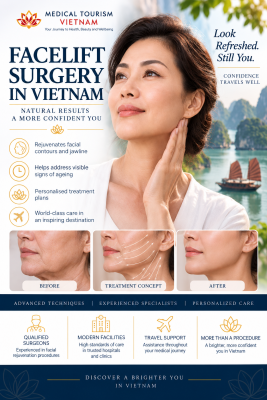
Facelift surgery, medically known as rhytidectomy, is a cosmetic surgical procedure designed to address selected age-related changes affecting the face and, depending on the technique, the upper neck.
Rather than simply “tightening the skin,” contemporary facelift surgery may involve repositioning deeper facial tissues, addressing skin laxity and improving the relationship between the cheeks, lower face, jawline and neck.
The appropriate technique varies considerably between patients. Facial anatomy, skin quality, degree of tissue descent, previous procedures and individual treatment goals should all influence surgical planning.
Patients considering a facelift as part of broader facial treatment may also wish to explore our guide to Facial Cosmetic Procedures in Vietnam.
What Is a Facelift?
A facelift is an operation intended to reposition selected facial tissues and improve contours that have changed with ageing.
Treatment commonly concentrates on the:
- Cheeks
- Lower face
- Jawline
- Jowls
- Area around the lower cheeks
- Upper neck, depending on the procedure
A facelift does not stop the ageing process and should not be expected to make someone look like a different person.
The aim should be an appropriate, balanced result that respects the patient’s natural facial characteristics.
What Changes Can Facelift Surgery Address?
Patients may consider facelift surgery because of concerns including:
- Reduced jawline definition
- Jowling
- Loose facial skin
- Descent of facial tissues
- Changes around the cheeks
- Deepening folds around the lower face
- Selected changes affecting the upper neck
Not every visible sign of facial ageing is best treated with a facelift.
Fine surface lines, pigmentation, eyelid changes and loss of facial volume may require different approaches.
A comprehensive facial assessment is therefore important before deciding on treatment.
Different Types of Facelift Surgery
“Facelift” does not describe one single operation.
Surgeons use different techniques depending on which tissues and areas of the face require treatment.
These may include variations described as:
- Traditional facelift
- Lower facelift
- SMAS facelift
- Deep-plane facelift
- Short-scar facelift
- Mini facelift
These terms can sometimes be used differently between surgeons.
Rather than choosing a procedure because of its name, patients should ask which anatomical structures the surgeon intends to treat, why that approach is recommended and what limitations it has.
What Is the SMAS?
The superficial musculoaponeurotic system (SMAS) is a layer of tissue beneath the skin that contributes to facial structure and movement.
Many contemporary facelift techniques address deeper supporting tissues rather than relying primarily on tension applied to the skin.
The precise approach varies according to the surgeon’s technique and the patient’s anatomy.
During consultation, patients should ask whether deeper tissues will be repositioned and how the proposed technique relates to their particular concerns.
What Is a Deep-Plane Facelift?
Deep-plane facelift techniques involve surgical dissection and repositioning within deeper facial tissue planes.
The term has become increasingly prominent in cosmetic surgery marketing, but it should not automatically be interpreted as meaning “better” than every other facelift technique.
Different approaches have different advantages, limitations and risks.
The surgeon’s training, experience, understanding of facial anatomy and ability to select an appropriate procedure are more important than choosing surgery because a particular technique is fashionable.
Facelift and the Jawline
Loss of jawline definition is a common reason people investigate facelift surgery.
Age-related changes can affect skin, fat distribution and deeper supporting structures, contributing to jowling or a less defined transition between the face and neck.
A facelift may reposition selected tissues to improve this contour.
However, jawline appearance can also be influenced by the chin, neck, facial volume and skeletal structure.
Assessment should therefore consider the whole face rather than one isolated feature.
Facelift and Neck Lift: What Is the Difference?
Facelift and neck lift surgery are closely related but are not necessarily the same procedure.
A facelift primarily addresses facial tissues and may include some treatment of the upper neck.
A neck lift concentrates more specifically on concerns beneath the jawline and through the neck.
Some patients may benefit from combined face and neck treatment, while others may require treatment predominantly in one area.
Facelift and Eyelid Surgery
A facelift does not directly correct excess upper-eyelid skin or many of the changes affecting the lower eyelids.
Patients concerned about both facial ageing and their eye area may sometimes consider blepharoplasty separately or in conjunction with other facial surgery.
Our guide to Eyelid Surgery in Vietnam explains upper and lower blepharoplasty, eye-health considerations and the relationship between eyelid and brow position.
Whether procedures should be combined requires individual assessment. Combining operations can increase surgical time, complexity and recovery requirements.
Facelift Surgery and Facial Volume
Facial ageing does not involve skin laxity alone.
Changes can also occur in:
- Facial fat
- Deeper soft tissues
- Bone structure
- Skin quality
- Facial proportions
For some patients, repositioning tissues may be sufficient. Others may require a different or complementary approach to address volume changes.
This is another reason facelift surgery should be individually planned rather than approached as a standard procedure.
Who May Be Suitable for Facelift Surgery?
Potential candidates are generally adults experiencing facial changes that may be appropriately addressed surgically and who have realistic expectations about treatment.
Assessment should consider:
- General health
- Facial anatomy
- Skin quality
- Degree of tissue laxity
- Previous facial surgery
- Previous non-surgical treatments
- Medications
- Smoking and nicotine use
- Healing history
- Expectations from surgery
Age alone does not determine whether someone is an appropriate candidate.
The pattern of facial ageing and the patient’s health are more informative than a particular birthday.
Smoking, Nicotine and Facelift Surgery
Smoking and nicotine exposure deserve particular attention with facelift surgery.
Facelift procedures involve lifting and repositioning tissues, making healthy blood circulation important for healing.
Smoking and nicotine can adversely affect blood flow and wound healing and may increase the risk of complications.
Patients should be completely open with their surgeon about smoking, vaping and other nicotine use.
The surgeon should provide individual instructions regarding cessation before and after surgery.
Your Facelift Consultation
A comprehensive consultation should involve assessment of the entire face and neck rather than simply the area that concerns the patient most.
Discussion may include:
- Facial proportions
- Skin quality
- Jawline
- Jowling
- Neck contour
- Facial volume
- Previous treatments
- Proposed surgical technique
- Incision placement
- Anaesthesia
- Scarring
- Recovery
- Risks
- Realistic outcomes
Patients should understand what the operation can and cannot reasonably change before deciding to proceed.
What Happens During Facelift Surgery?
The exact procedure depends on the surgical technique.
Incisions are commonly positioned around natural contours near the ears and hairline, although their extent varies according to the operation.
The surgeon may then reposition selected deeper tissues, address excess skin and refine facial contours according to the surgical plan.
Some procedures also involve treatment beneath the chin or through the neck.
Facelift surgery should therefore be explained according to the specific operation being proposed, rather than through a generic description.
Anaesthesia
Facelift surgery may be performed using different anaesthetic approaches depending on the extent of surgery, surgeon, facility and patient circumstances.
Patients should understand:
- Which form of anaesthesia is proposed
- Who will administer it
- Where surgery will take place
- What monitoring will be used
- Whether overnight hospital observation is expected
The treating team should provide individual instructions.
Where Are Facelift Scars Located?
Facelift surgery involves incisions and therefore produces scars.
Surgeons generally position incisions around natural anatomical features such as the hairline and contours around the ears, where possible.
Scar appearance varies according to:
- Surgical technique
- Extent of surgery
- Skin characteristics
- Individual healing
- Tension on the wound
- Smoking and nicotine exposure
- Previous surgery
Patients should ask to see where their proposed incisions will be located before proceeding.
No surgical facelift should be promoted as completely scarless.
Recovery After Facelift Surgery
Swelling, bruising, tightness and altered sensation can occur after facelift surgery.
The degree and duration vary between patients and according to the extent of surgery.
Your surgeon should provide individual instructions regarding:
- Wound care
- Hair washing
- Sleeping position
- Physical activity
- Returning to work
- Cosmetics
- Sun exposure
- Follow-up appointments
- Travel
- Symptoms requiring medical attention
The old MTV page prescribed fixed periods for activities, dressings and exercise. Those timelines should instead be determined by the treating surgeon because recovery varies with the procedure and the individual.
When Will I See the Result?
Facelift results should not be judged immediately after surgery.
Early swelling and bruising can temporarily obscure facial contours.
As healing progresses, the result becomes easier to evaluate, while incision lines and deeper tissues continue to mature over time.
Your surgeon should explain when the outcome can reasonably be assessed based on the procedure performed.
How Long Does a Facelift Last?
A facelift does not stop ageing.
Surgery can reposition tissues and alter facial contours, but the face continues to change naturally with time.
Longevity varies according to factors including:
- Surgical technique
- Facial anatomy
- Skin quality
- Ageing
- Weight changes
- Smoking
- Sun exposure
- General health
For this reason, we are removing the old page’s claim that facelift surgery lasts “five years upwards.”
Patients should instead discuss realistic long-term expectations with their surgeon.
Risks and Possible Complications
Facelift surgery carries potential risks.
These can include:
- Bleeding or haematoma
- Infection
- Delayed wound healing
- Scarring
- Skin loss
- Changes in sensation
- Facial asymmetry
- Hairline changes or localised hair loss
- Fluid collection
- Anaesthesia-related complications
- Unsatisfactory cosmetic outcome
- Need for revision surgery
Facial nerve injury is an uncommon but potentially significant complication because branches of the facial nerve control facial movement.
The existing MTV article correctly recognises bleeding, skin circulation problems and potential nerve injury as important complications, although its presentation is being modernised here.
Patients should understand the warning signs requiring urgent assessment before leaving the treating facility.
Facelift Surgery Versus Non-Surgical Treatments
Non-surgical treatments and facelift surgery should not be regarded as interchangeable.
Depending on the concern, non-surgical options may address:
- Skin texture
- Selected wrinkles
- Facial volume
- Pigmentation
- Other superficial changes
They generally cannot reproduce the degree of tissue repositioning possible with surgical facelift techniques.
Conversely, a facelift does not necessarily correct every surface change in ageing skin.
The appropriate treatment depends on the anatomy and the patient’s objectives.
Why Consider Facelift Surgery in Vietnam?
Vietnam has a developing private healthcare and cosmetic surgery sector, particularly in major centres such as Ho Chi Minh City and Hanoi.
International patients considering facelift surgery should evaluate providers on clinical criteria rather than price alone.
Important considerations include:
- Surgeon’s qualifications
- Experience in facial plastic surgery
- Experience with the proposed facelift technique
- Hospital or surgical facility standards
- Anaesthesia arrangements
- Preoperative assessment
- Postoperative monitoring
- Follow-up care
- Management of complications
- International patient support
The goal is not simply to find a procedure overseas, but to identify an appropriate treatment pathway with adequate assessment and follow-up.
Planning Facelift Surgery in Vietnam
Facelift surgery requires more planning than fitting a procedure into a holiday.
International patients should establish:
- How long they should remain in Vietnam
- Whether hospital admission is required
- When follow-up appointments will occur
- When sutures or other postoperative care will be required
- When the surgeon considers air travel appropriate
- What support is available after discharge
- How complications would be managed
- What follow-up is available after returning home
Visible swelling and bruising may also influence travel and accommodation plans.
Your medical and recovery requirements should determine your itinerary, rather than the itinerary determining your treatment.
Questions to Ask Your Surgeon
Before proceeding, consider asking:
- Which facelift technique do you recommend for me and why?
- Which anatomical areas will the procedure address?
- Will my neck also be treated?
- Will deeper facial tissues be repositioned?
- Where will my incisions be located?
- What type of anaesthesia will be used?
- What are the most important risks in my case?
- How frequently do you perform this procedure?
- What recovery should I realistically expect?
- How long should I remain in Vietnam?
- What happens if I develop a complication after returning home?
- What is your policy regarding revision surgery?
Clear answers are an important part of informed decision-making.
Considering Facelift Surgery in Vietnam?
If you are exploring facelift surgery or other facial cosmetic procedures in Vietnam, Medical Tourism Vietnam can help you take the next step.
We can assist with preliminary enquiries and information regarding:
- Specialist consultations
- Available facelift approaches
- Preliminary provider assessment where available
- Indicative treatment costs
- Expected length of stay
- Appointment availability
- International patient arrangements
- Related facial procedures
Enquire About Facelift Surgery in Vietnam
There is no obligation to proceed. Final medical suitability, treatment recommendations and quotations are determined by the treating healthcare provider following individual assessment.
Continue Exploring Facial Cosmetic Procedures
← Facial Cosmetic Procedures in Vietnam
Medical Disclaimer
The information provided on this page is for general educational purposes only and does not constitute medical advice, diagnosis or a recommendation for treatment.
Facelift surgery is an invasive surgical procedure and carries potential risks. Suitability, surgical technique, expected outcomes and recovery depend on individual health, facial anatomy and other circumstances. Anyone considering treatment should obtain an individual assessment from an appropriately qualified healthcare professional and understand the potential benefits, limitations and risks before proceeding.
About the Author
George Adams is the founder and editor of Medical Tourism Vietnam and Hanoi Trading Post. He writes on healthcare, medical tourism and developments in specialist medical treatment across Asia.
Editorial Policy
Medical Tourism Vietnam publishes patient-focused educational information intended to help international patients better understand healthcare and treatment options. Provider information, where included, is presented in an educational context and does not constitute a guarantee of suitability or treatment outcome.
Last Reviewed: 7 September 2026