





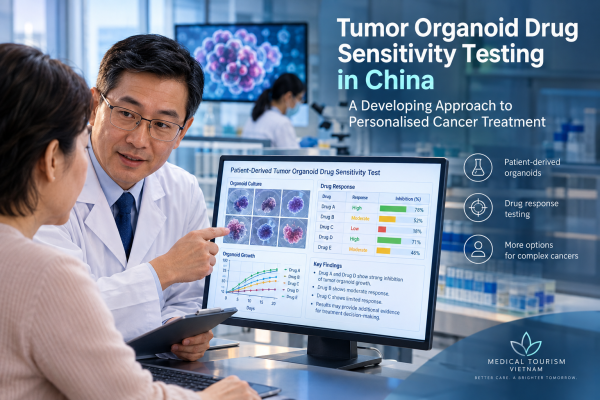
Tumor organoid drug sensitivity testing uses patient-derived tumor models to evaluate responses to selected cancer drugs in the laboratory, providing additional information that may support personalised treatment decisions.
A Developing Approach to Personalised Cancer Treatment
Tumor organoid drug sensitivity testing in China is emerging as an additional tool for specialists treating patients with recurrent, refractory or complex solid tumors.
The technology involves creating a three-dimensional laboratory model from a patient’s own tumor cells. This patient-derived tumor organoid can then be exposed to selected anti-cancer drugs and drug combinations to observe how the tumor cells respond under controlled laboratory conditions.
Rather than replacing established oncology assessment, organoid testing may provide specialists with another source of patient-specific information when considering treatment options.
What Is a Patient-Derived Tumor Organoid?
A tumor organoid is a three-dimensional laboratory model grown from cells obtained from a patient’s tumor.
Under specialised culture conditions, these cells can develop into small structures that retain important characteristics of the original cancer, including aspects of its molecular and biological behaviour.
They are sometimes described as “mini-tumors”, although this description should not be taken literally. An organoid cannot reproduce every feature of a cancer growing inside the human body.
Its value lies in providing researchers and specialists with a living model of the patient’s tumor that can potentially be studied outside the body.
How Does Drug Sensitivity Testing Work?
Where an appropriate tumor sample is available, the process may involve:
- Obtaining suitable tumor tissue through surgery, biopsy or another clinically appropriate procedure.
- Isolating viable tumor cells.
- Growing patient-derived tumor organoids in specialised laboratory conditions.
- Exposing the organoids to selected cancer drugs or combinations.
- Measuring changes in tumor-cell growth or survival.
- Providing the findings to the treating oncology team for clinical consideration.
The objective is not simply to identify whether a particular drug is associated with a particular cancer type.
Instead, specialists are attempting to observe how an individual patient’s tumor model responds to candidate treatments in the laboratory.
Which Patients May Be Considered?
Tumor organoid testing may be considered particularly relevant when treatment decisions have become complex.
This can include selected patients with:
- Recurrent cancer
- Treatment-resistant or refractory disease
- Advanced solid tumors
- Limited conventional treatment options
- Tumors for which several possible treatment strategies are being considered
A specialist oncology assessment remains necessary to determine whether organoid testing is appropriate and whether suitable tumor material is available.
Solid Tumors That May Be Evaluated
According to information provided by GoBroad Healthcare Group, its tumor organoid program may support treatment assessment for a range of solid tumors, including:
- Lung cancer
- Gastric cancer
- Colorectal cancer
- Pancreatic cancer
- Breast cancer
- Melanoma
- Sarcoma
- Other selected solid tumors
Eligibility depends on the individual patient’s diagnosis, previous treatment, availability and suitability of tumor material, and specialist assessment.
How Is This Different From Genomic Testing?
Genomic testing examines the molecular characteristics of a cancer and may identify mutations or biomarkers associated with particular treatments.
Organoid drug sensitivity testing asks a somewhat different question:
How does this patient’s tumor model actually respond when exposed to a particular drug in the laboratory?
The two approaches therefore need not compete.
Genomic information can help specialists understand what biological characteristics a tumor possesses, while functional testing may provide additional information about how the tumor behaves when exposed to treatment.
Research into functional precision oncology increasingly explores ways of combining these different sources of information when treatment decisions are particularly difficult.
Understanding the Limitations
Tumor organoid testing is promising, but patients should understand its limitations.
A drug that appears effective against tumor cells in a laboratory organoid will not necessarily produce the same response in the patient.
The human body contains biological factors that cannot always be fully reproduced in an organoid model, including:
- The immune system
- Blood supply
- Drug metabolism
- Interactions with surrounding tissues
- The wider tumor microenvironment
- Treatment toxicity and individual patient tolerance
It may also not be possible to successfully establish a usable organoid from every tumor sample.
For these reasons, organoid testing should be regarded as additional evidence to support specialist decision-making, rather than as a test that can guarantee which treatment will work.
GoBroad Healthcare Group and Tumor Organoid Testing
GoBroad Healthcare Group has advised Medical Tourism Vietnam that it provides tumor organoid drug sensitivity testing for selected patients with recurrent, refractory or complex solid tumors.
The program involves developing patient-derived tumor models and evaluating candidate drugs and combinations in vitro.
The resulting laboratory information may then provide additional evidence for specialists considering personalised treatment strategies.
GoBroad’s international patient services can also include preliminary medical-record review and specialist evaluation to determine whether further assessment may be appropriate.
International Patient Assessment
International patients considering advanced cancer treatment in China should ideally have their medical information reviewed before making travel arrangements.
Information requested for preliminary assessment may include:
- Pathology reports
- Imaging reports and scans
- Previous treatment history
- Surgical records
- Molecular or genomic testing results
- Current medications
- Recent oncology reports
- Information regarding available tumor tissue or biopsy material
Following review, specialists can advise whether further assessment — including potential organoid testing — may be clinically appropriate.
How Medical Tourism Vietnam Can Assist
Medical Tourism Vietnam provides educational information and patient-support services for international patients exploring specialist treatment options in China.
Where appropriate, we can assist patients with organising medical information for preliminary specialist review and communicating with international patient departments.
Medical Tourism Vietnam does not determine treatment suitability or recommend a particular cancer drug. Clinical decisions remain the responsibility of appropriately qualified treating specialists in consultation with the patient.
Related Reading
Could a Patient’s Tumor Help Doctors Choose the Right Drug? The Emerging Role of Cancer Organoids
Our companion feature on Hanoi Trading Post examines the science behind patient-derived tumor organoids, their emerging role in functional precision oncology, and the important limitations patients should understand.
Continue Exploring Cancer Care in China
Patients researching advanced cancer treatment may also wish to explore:
- Cancer Care at Xi’an Chang’an Hospital
- New CAR-T Therapy in China for Advanced Stomach Cancer
- GoBroad Healthcare Group | Stem Cell Transplantation
- Exploring Advanced Treatment Options in China
Medical Disclaimer
The information on this page is provided for general educational purposes and does not constitute medical advice, diagnosis or a recommendation for treatment.
Tumor organoid drug sensitivity testing is an evolving field. Laboratory sensitivity does not guarantee clinical response. Treatment decisions should be made by appropriately qualified oncology specialists after consideration of the patient’s diagnosis, medical history, previous treatment, diagnostic findings and individual circumstances.
About the Author
George Adams is the founder and editor of Medical Tourism Vietnam and Hanoi Trading Post. He writes on healthcare, medical tourism and developments in specialist medical treatment across Asia.
Editorial Policy
Medical Tourism Vietnam publishes independent, patient-focused educational information intended to help international patients better understand healthcare and treatment options. Provider-supplied information is contextualised and presented separately from independent educational content.
Last Reviewed
14 August 2026