





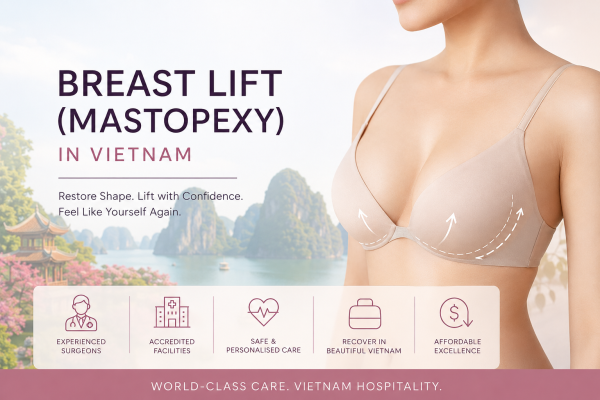
Breast lift surgery, medically known as mastopexy, is a cosmetic surgical procedure designed to raise and reshape breasts that have changed in position, firmness or contour.
Pregnancy, breastfeeding, weight changes, ageing and natural differences in skin elasticity can all affect breast shape over time. A breast lift removes excess skin and reshapes the supporting breast tissue to create a firmer, more elevated contour. The nipple and areola can also be repositioned where appropriate.
For women considering breast lift surgery in Vietnam, the decision involves more than choosing a procedure. Selecting an appropriately qualified surgeon, understanding realistic outcomes and planning recovery and follow-up are equally important.
Medical Tourism Vietnam can help international patients explore available options and make preliminary enquiries before deciding whether to proceed.
What Is a Breast Lift?
A breast lift reshapes and raises existing breast tissue rather than primarily increasing or substantially reducing breast volume.
During surgery, excess skin is removed and the remaining breast tissue is reshaped. The nipple and areola are generally repositioned to suit the new breast contour.
Depending on the patient’s anatomy and desired outcome, breast lift surgery may be performed alone or considered alongside breast augmentation or reduction.
The appropriate technique depends on factors including:
- Degree of breast sagging or ptosis
- Breast size and shape
- Skin quality and elasticity
- Nipple and areola position
- Existing breast volume
- Breast symmetry
- Previous surgery
- Desired outcome
Individual surgical assessment is essential because the same technique is not appropriate for every patient.
Why Do Patients Consider Breast Lift Surgery?
Patients may consider mastopexy when breast shape or position has changed following:
- Pregnancy and breastfeeding
- Significant weight loss
- Changes in body weight
- Ageing
- Loss of skin elasticity
- Natural breast development
- Previous breast surgery
Some women are primarily concerned about downward nipple position, while others may be concerned about loose skin, reduced upper-breast fullness or asymmetry.
A consultation should establish what the patient actually wants to change and whether a breast lift alone is likely to achieve that objective.
Breast Lift vs Breast Augmentation vs Breast Reduction
These procedures are related, but they address different concerns.
Breast Lift
A breast lift (mastopexy) primarily raises and reshapes the breasts. It does not primarily aim to make the breasts substantially larger or smaller.
Breast Augmentation
Breast augmentation primarily increases breast volume, usually using implants or, in selected cases, fat transfer.
An augmentation alone does not necessarily correct significant breast sagging.
Breast Reduction
Breast reduction removes breast tissue, fat and skin to make the breasts smaller and lighter. Because the breast is also reshaped, breast reduction generally incorporates a lifting effect.
For some patients, a surgeon may recommend combining a breast lift with augmentation when both breast position and volume are concerns.
The appropriate procedure should be determined by anatomy and treatment goals rather than by the name of a procedure seen online.
Breast Lift Techniques
Different incision patterns may be used depending on the degree of lifting required and the patient’s anatomy.
Periareolar Lift
An incision is made around the edge of the areola. This approach may be suitable for selected patients requiring relatively limited correction.
Vertical or “Lollipop” Lift
The incision generally extends around the areola and vertically towards the breast crease.
This technique allows more substantial reshaping than a periareolar approach.
Anchor or Inverted-T Lift
The incision generally extends around the areola, vertically down the breast and along the breast crease.
This approach may be recommended when more extensive lifting and skin removal are required.
The surgeon should explain why a particular technique is being recommended and where the resulting scars are expected to be located.
Who May Be Suitable?
Potential candidates may include adults who:
- Are in generally good health
- Have realistic expectations
- Are concerned about breast sagging or changes in shape
- Have maintained a reasonably stable weight
- Understand that surgery will produce permanent scars
- Are prepared for postoperative recovery and follow-up
Smoking can interfere with blood supply and wound healing and may increase the risk of complications.
Future pregnancy and substantial weight changes can also alter breast shape and affect the results of previous breast-lift surgery.
Consultation and Personal Assessment
A comprehensive consultation should take place before deciding on surgery.
The surgeon may assess:
- Medical history
- Previous breast surgery
- Current medications and supplements
- Breast size and shape
- Skin quality
- Breast symmetry
- Nipple and areola position
- Existing breast volume
- Personal goals
- Pregnancy and breastfeeding plans
- Smoking status
Depending on age, medical history and individual circumstances, breast imaging or other investigations may also be recommended.
The consultation should provide an opportunity to discuss realistic results rather than simply select a preferred appearance from photographs.
Scarring
Breast lift surgery produces permanent scars.
Their location and extent depend largely on the technique required.
Although surgeons generally aim to position scars as discreetly as practical, patients should understand that scars will not disappear completely.
Scars normally change and mature over time, and their eventual appearance varies between individuals.
Before proceeding, patients should ask the surgeon to show exactly where their anticipated scars will be located.
Breastfeeding and Nipple Sensation
Breast lift surgery can affect nipple sensation and, depending on the technique used, may potentially affect breastfeeding.
Some patients experience temporary changes in breast or nipple sensation, while changes can occasionally be permanent.
Women hoping to breastfeed in the future should discuss this specifically with their surgeon before deciding on surgery.
Future pregnancy and breastfeeding may also change breast size and shape after a previous lift.
Recovery After Breast Lift Surgery
Recovery varies between patients and according to the extent of surgery.
During early recovery, patients may experience:
- Swelling
- Bruising
- Tenderness
- Tightness
- Temporary changes in sensation
Dressings and a surgical or supportive bra may be recommended.
Patients should follow their surgeon’s individual instructions regarding wound care, bathing, sleeping position, physical activity, driving and returning to work.
Rather than assuming a fixed recovery period, international patients should allow enough flexibility for postoperative assessment before travelling home.
Expected Results
Breast lift surgery can raise and reshape the breasts, but results vary according to individual anatomy, skin quality, ageing and future changes in body weight.
Surgery cannot permanently prevent the natural effects of ageing or gravity.
Pregnancy and substantial weight changes can also alter the result over time.
Patients should therefore approach breast lift surgery with the goal of improvement rather than perfection.
Risks and Considerations
Like all surgical procedures, mastopexy carries potential risks.
These can include:
- Bleeding or haematoma
- Infection
- Delayed or poor wound healing
- Changes in nipple or breast sensation
- Breast asymmetry
- Unfavourable scarring
- Changes in breast contour
- Partial loss of nipple or areolar tissue in uncommon cases
- Anaesthetic complications
- Blood clots
- Need for revision or further surgery
Individual risk depends on factors including general health, smoking status, anatomy, surgical technique and whether additional procedures are performed.
Potential complications should be discussed directly with the treating surgeon before informed consent is given.
Why Consider Breast Lift Surgery in Vietnam?
Vietnam’s private healthcare and cosmetic-surgery sector has developed considerably, with specialist hospitals and aesthetic facilities serving both Vietnamese and international patients.
For overseas patients, Vietnam may offer access to cosmetic-surgery consultations and treatment while also providing international-patient services at selected healthcare providers.
However, the decision should never be based on price alone.
Patients should consider:
- Surgeon qualifications and experience
- Experience specifically with breast surgery
- Hospital or surgical-facility standards
- Anaesthesia arrangements
- Preoperative assessment
- Communication and language support
- Postoperative nursing and medical care
- How complications are managed
- Recommended length of stay in Vietnam
- Follow-up after returning home
- What is included in the treatment quotation
The objective is not simply to find a procedure overseas, but to identify a treatment pathway appropriate to the individual patient.
Planning Your Stay in Vietnam
International patients should allow sufficient time for consultation, surgery, initial recovery and postoperative review.
A treatment journey may involve:
Preliminary enquiry → medical information or photographs where requested → surgeon review → consultation → treatment plan and quotation → travel arrangements → in-person assessment → surgery → postoperative review → return home → follow-up.
The precise process varies between healthcare providers.
Patients should avoid booking inflexible return flights until they understand the surgeon’s recommended postoperative stay.
Questions to Ask Your Surgeon
Before deciding on breast lift surgery, consider asking:
- Am I a suitable candidate for mastopexy?
- Would a breast lift alone achieve my goals?
- Should I consider augmentation or reduction instead?
- Which breast-lift technique do you recommend and why?
- Where will my scars be located?
- What results are realistic for me?
- Could surgery affect nipple sensation?
- Could it affect future breastfeeding?
- What are my individual risks?
- Where will the surgery be performed?
- Who will administer the anaesthetic?
- How are complications managed?
- How long should I remain in Vietnam?
- What follow-up is available after I return home?
Patients should feel comfortable asking questions and should understand the proposed treatment before deciding whether to proceed.
Considering Breast Lift Surgery in Vietnam?
If you are exploring breast lift surgery in Vietnam, Medical Tourism Vietnam can help you take the next step.
We can assist international patients with preliminary enquiries and help obtain information from suitable healthcare providers about:
- Available breast-lift procedures
- Surgeon assessment
- Potential treatment options
- Indicative treatment costs
- Recommended length of stay
- International-patient arrangements
- Consultation and appointment options
Request Information
If you would like to explore your options, contact Medical Tourism Vietnam with a brief description of what you are considering.
Where appropriate, we can help direct your enquiry to a suitable healthcare provider for preliminary review.
There is no obligation to proceed.
Final medical suitability, treatment recommendations and quotations are determined by the treating healthcare provider following individual assessment.
I would link this button to your existing MTV contact/patient enquiry pathway, rather than directly to a hospital. That is important for the commercial model we’re now developing.
Continue Exploring Cosmetic Surgery in Vietnam
Use these internal links:
- Cosmetic Surgery in Vietnam
- Breast Augmentation in Vietnam
- Breast Reduction Surgery in Vietnam
- Abdominoplasty (Tummy Tuck) in Vietnam
- Body Lift Surgery in Vietnam | Arm, Thigh & Buttock Lifts
- Liposuction in Vietnam
- Gluteal Augmentation in Vietnam
- Kangnam Aesthetic Hospital Hanoi
Medical Disclaimer
The information provided on this page is for general educational purposes only and does not constitute medical advice, diagnosis or a recommendation for treatment.
Breast lift surgery is a surgical procedure with potential risks and complications. Suitability, surgical technique, expected outcomes and recovery vary between individuals. Anyone considering cosmetic surgery should obtain an individual assessment from an appropriately qualified medical practitioner and understand the potential benefits, limitations and risks before proceeding.
About the Author
George Adams is the founder and editor of Medical Tourism Vietnam and Hanoi Trading Post. He writes on healthcare, medical tourism and developments in specialist medical treatment across Asia.
Editorial Policy
Medical Tourism Vietnam publishes independent, patient-focused educational information intended to help international patients understand healthcare and treatment options. Provider information, where included, is presented in an educational context and does not constitute a medical recommendation.
Last Reviewed
25 August 2026