





A New Treatment Option Offering Hope
Receiving a diagnosis of advanced stomach cancer can be overwhelming, particularly when conventional treatments have stopped working. While surgery, chemotherapy and targeted therapies remain important treatment options, researchers continue to develop new ways of helping the body’s own immune system fight cancer.
One of the most significant recent advances is CAR-T cell therapy. Until recently, CAR-T treatments had been used primarily for certain blood cancers. In June 2026, however, China approved the world’s first CAR-T therapy for a solid tumour, offering a new treatment option for some patients with advanced stomach cancer and gastroesophageal junction adenocarcinoma.
This page explains the treatment in straightforward language, who may be eligible, and why this development is attracting international attention.
What is CAR-T Therapy?
Think of your immune system as your body’s security team.
One of its most important defenders is a type of white blood cell called a T cell. Normally these cells patrol the body looking for viruses, bacteria and abnormal cells. Unfortunately, many cancers develop ways of hiding from these natural defences.
CAR-T therapy changes that.
Doctors collect some of the patient’s own T cells from the bloodstream. These cells are then sent to a specialised laboratory, where they are genetically modified to recognise a specific marker found on cancer cells. Once millions of these enhanced cells have been grown, they are returned to the patient’s body through an intravenous infusion.
Their mission is simple: recognise the cancer cells and attack them.
Because the cells come from the patient, CAR-T therapy is a highly personalised form of cancer treatment.
What is Stomach Cancer?
Stomach cancer, also known as gastric cancer, develops in the lining of the stomach. Some patients develop cancer where the oesophagus joins the stomach, known as gastroesophageal junction (GEJ) adenocarcinoma.
When these cancers are diagnosed at an advanced stage, treatment may involve surgery, chemotherapy, targeted therapy or immunotherapy. Unfortunately, not every patient responds to these treatments, creating a need for additional options.
What is Claudin18.2?
Claudin18.2 (CLDN18.2) is a protein found on the surface of certain stomach cancer cells.
An easy way to think about it is as a unique identification badge.
If a patient’s tumour carries this marker, specially engineered CAR-T cells can be trained to recognise it and attack those cancer cells.
Not every stomach cancer has this marker, so patients must first undergo testing to determine whether they are Claudin18.2-positive before this treatment can be considered.
Why is This Approval Important?
For many years, CAR-T therapy has produced impressive results in several blood cancers.
Solid tumours, however, have proved much more difficult because cancer cells often create an environment that prevents immune cells from reaching or destroying them effectively.
China’s approval of Satricabtagene Autoleucel (satri-cel) represents an important milestone because it is the world’s first approved CAR-T therapy for a solid tumour. The approval follows clinical studies that demonstrated improved progression-free survival and overall survival for eligible patients when compared with existing treatment options.
While the therapy is not suitable for everyone, it offers a new possibility for patients whose previous treatments have not been successful.
Who May Be Eligible?
According to current approval criteria, patients may be considered if they:
- Have advanced stomach (gastric) cancer or gastroesophageal junction adenocarcinoma.
- Test positive for Claudin18.2 (CLDN18.2).
- Are HER2-negative.
- Have previously received at least two lines of treatment without success.
- Meet other medical criteria determined by their treating specialists.
Every patient requires a detailed medical assessment before treatment can be recommended.
What Does Treatment Involve?
The illustration below provides a simplified overview of the typical CAR-T treatment journey. Individual treatment plans vary according to each patient’s diagnosis, overall health, and the recommendations of the treating medical team.
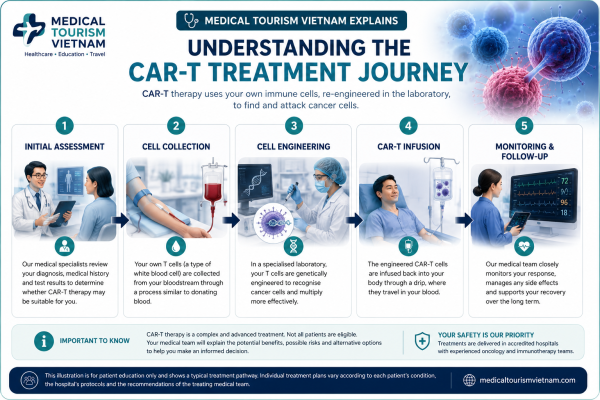
The treatment journey generally includes:
- Medical assessment and eligibility testing.
- Collection of the patient’s own immune (T) cells.
- Manufacture of personalised CAR-T cells in a specialised laboratory.
- Intravenous infusion of the CAR-T cells.
- Careful monitoring and follow-up after treatment.
Because every patient’s condition is different, treatment plans are tailored to individual needs.
Why China?
China has become one of the world’s leading centres for advanced cellular therapies, precision oncology and clinical research.
Significant investment in biotechnology, combined with extensive clinical experience, has enabled Chinese researchers and hospitals to play a leading role in developing innovative treatments for patients with complex cancers.
For suitable international patients, specialist centres now offer multidisciplinary assessment, treatment planning and ongoing follow-up supported by experienced oncology teams.
Featured Healthcare Provider
GoBroad Healthcare Group
GoBroad Healthcare Group is one of the specialist healthcare organisations in China offering assessment and treatment for eligible patients receiving satri-cel CAR-T therapy. The organisation participated in the clinical research that contributed to the development of this innovative treatment and now provides multidisciplinary cancer care for appropriately selected patients.
How Medical Tourism Vietnam Can Help
Choosing medical treatment overseas involves much more than selecting a hospital. Understanding treatment options, eligibility requirements, travel planning and post-treatment considerations can be challenging, particularly when navigating a different healthcare system.
Medical Tourism Vietnam is an independent patient information and facilitation platform. We help patients understand available treatment options, answer general questions about the medical journey, and, where appropriate, facilitate introductions to reputable healthcare providers within our professional network.
Every patient’s circumstances are unique. Before any referral is considered, we encourage patients to obtain relevant medical records so that an appropriate preliminary assessment can be undertaken by the treating specialists.
To learn more about this treatment pathway or to discuss whether it may be suitable for your individual circumstances, please contact Medical Tourism Vietnam.
About the Author
George Adams is the founder and publisher of Medical Tourism Vietnam and Hanoi Trading Post. With extensive international experience spanning education, aviation, international business development and cross-cultural communication, he is committed to making complex healthcare topics easier to understand through clear, balanced and independent information. His work focuses on helping international patients make informed decisions about healthcare options across Vietnam, China and the wider Asia-Pacific region.
Editorial Policy
Medical Tourism Vietnam is committed to publishing balanced, evidence-informed healthcare information that places patients’ interests first. Our content is designed to educate, improve understanding and support informed decision-making.
Medical Tourism Vietnam does not provide medical treatment, diagnose medical conditions or recommend one healthcare provider over another. Where appropriate, we may facilitate introductions to carefully selected healthcare organisations within our professional network, allowing patients to make informed decisions based on their own medical needs and the advice of qualified healthcare professionals.
Our editorial content is prepared independently and aims to present emerging healthcare developments in clear, accessible language for an international audience.
Medical Disclaimer
The information provided on Medical Tourism Vietnam is intended for educational purposes only and should not be regarded as medical advice, diagnosis or treatment.
Every patient’s medical condition is unique. Treatment suitability, expected outcomes and associated risks vary between individuals. Readers should always consult qualified healthcare professionals regarding diagnosis, treatment options and personal medical decisions.
Where international treatment is being considered, eligibility for specialist therapies is determined solely by the treating healthcare provider following a comprehensive medical assessment.
Last Reviewed: 2 July 2026
Content Type: Patient Education
Reviewed by: Medical Tourism Vietnam Editorial Team